


Design Systems
Defining and Describing Design Systems
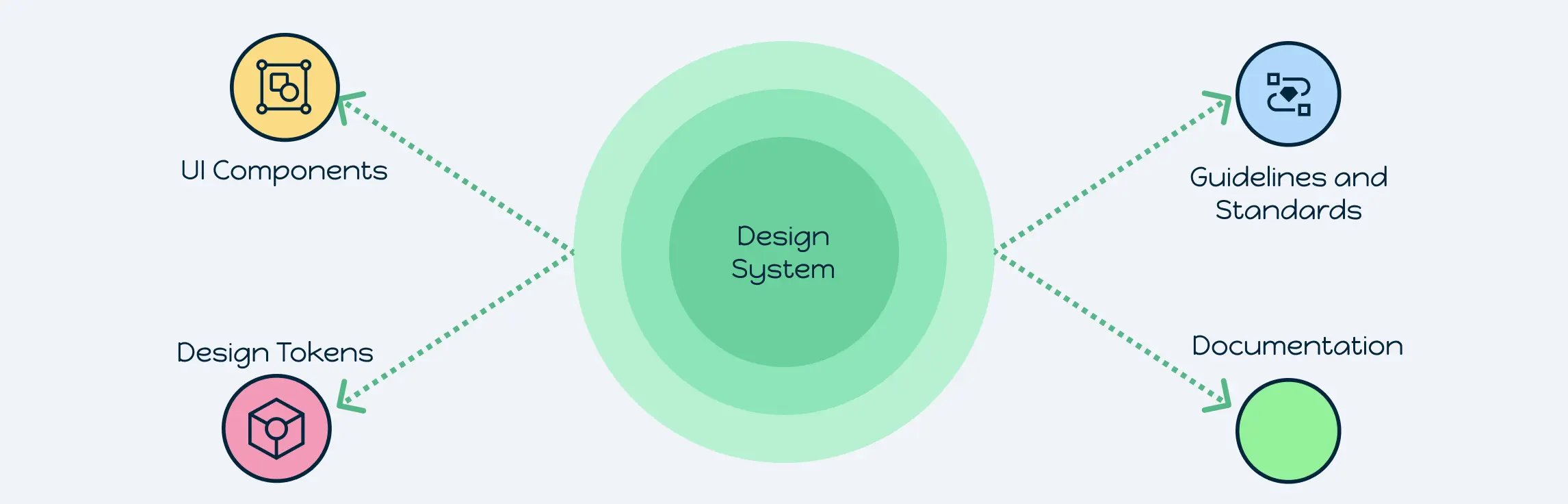
graph TD
A[Design Tokens<br|>colors, spacing, typography] --> B[Reusable Components<br|>buttons, cards, modals]
B --> C[Standards & Guidelines<br|>usage rules, documentation]
C --> D[Applications<br|>consistent products across platforms]
style A fill:#f9f
style B fill:#bbf
_Design systems are centralized collections of reusable components, design tokens, and guidelines that ensure consistent, scalable design across products and teams.
[z65dyl]
[t3baak]
A design system is "a collection of reusable components, guided by clear standards, that can be assembled to build applications."
[z65dyl]
Design tokens serve as "the foundational building blocks—the visual design atoms like colors, spacing, and typography that power your design system," enabling platform-agnostic consistency across CSS, iOS, Android, and more.
[z65dyl]
They matter for ensuring consistency, speeding workflows, creating shared design-engineering language, easing updates, and scaling across teams.
[z65dyl]
[t3baak]
Uses in Context
- In product development, design systems "ensure consistency across products and platforms" by providing reusable UI building blocks. [z65dyl]
- Teams use them to "speed up design and development workflows" and achieve "135% ROI across design and engineering costs." [t3baak]
- In scaling enterprises, they combat "design chaos" like off-brand visuals and inconsistent UX, with designers completing tasks "34% faster." [t3baak]
- For multi-platform work, design tokens are "named entities that store visual design attributes" generating code for web, iOS, Android. [z65dyl]
- In team growth scenarios, they address "systems problems" like multiple component versions and lack of ownership. [eb43mb]
History of Use
Origins
The formalized concept of design systems emerged from indie design practitioners and startups in the 2010s, building on earlier pattern library ideas, though search results emphasize practical guides over a single originating paper or post.
[z65dyl]
Key early framing appears in resources like Design.dev's guide, defining it as "a complete guide to building scalable design systems with design tokens," reflecting practitioner-driven origins in scalable UI consistency.
[z65dyl]
Evolution
- 2020s: Focus shifted to resilience and multi-brand architectures, with guides on "designing beyond the happy path" covering edge states and inclusive interactions. [mh7pai]
- 2026: Emphasis on enterprise ROI and efficiency, noting design systems as "strategic assets" cutting duplication in distributed teams. [t3baak]
Best Real-World Examples
- Zeroheight platform for resilient design systems with checklists for technical states and user preferences. [mh7pai]
- Design Systems Collective on monolithic vs. federated architectures using tokens for brand diversity. [6fwfqt]
Case Studies
Harvey AI, a startup scaling AI products, rebuilt their design system in early 2026 when "product complexity was growing faster than our design infrastructure could support."
[eb43mb]
Facing expansion into new pillars, growing Design and Engineering teams, and diverse surfaces, they dealt with "multiple versions of the same component" and no clear ownership.
[eb43mb]
The EPD team re-architected for quality consistency, establishing contribution processes that accelerated shipping without sacrificing standards, demonstrating how design systems solve "systems problems" slowing entire organizations.
[eb43mb]
This shows design systems as essential infrastructure for startups outpacing ad-hoc design in high-growth phases.
ZeroHeight's approach, via designer Stéphanie Walter's 2020s checklist, evolved design systems "beyond the happy path" to include technical states, layouts, inclusive interactions, and user preferences.
[mh7pai]
This practitioner-led framework addressed common pitfalls in early systems, enabling resilient documentation and delivery tools that automate workflows and measure adoption.
[mh7pai]
By prioritizing visual, searchable docs aligned with code, it proved how indie-focused evolutions make systems usable across distributed teams, countering abandonment risks.
[mh7pai]
[t3baak]
Superside's 2026 analysis of design systems as "the antidote" to chaos framed them as "centralized collections of brand-approved assets, reusable UI components, design patterns, documentation and rules."
[t3baak]
Drawing from Figma data, it highlighted "34% faster task completion" and ROI, with success tied to "clear ownership, usable components, strong documentation and real adoption."
[t3baak]
Starting small and evolving via feedback, this startup perspective underscores design systems' role in protecting brand equity at scale for creative teams.
[t3baak]