Impute Marketing

Brand Identity Product Design Customer Journeys User Journeys
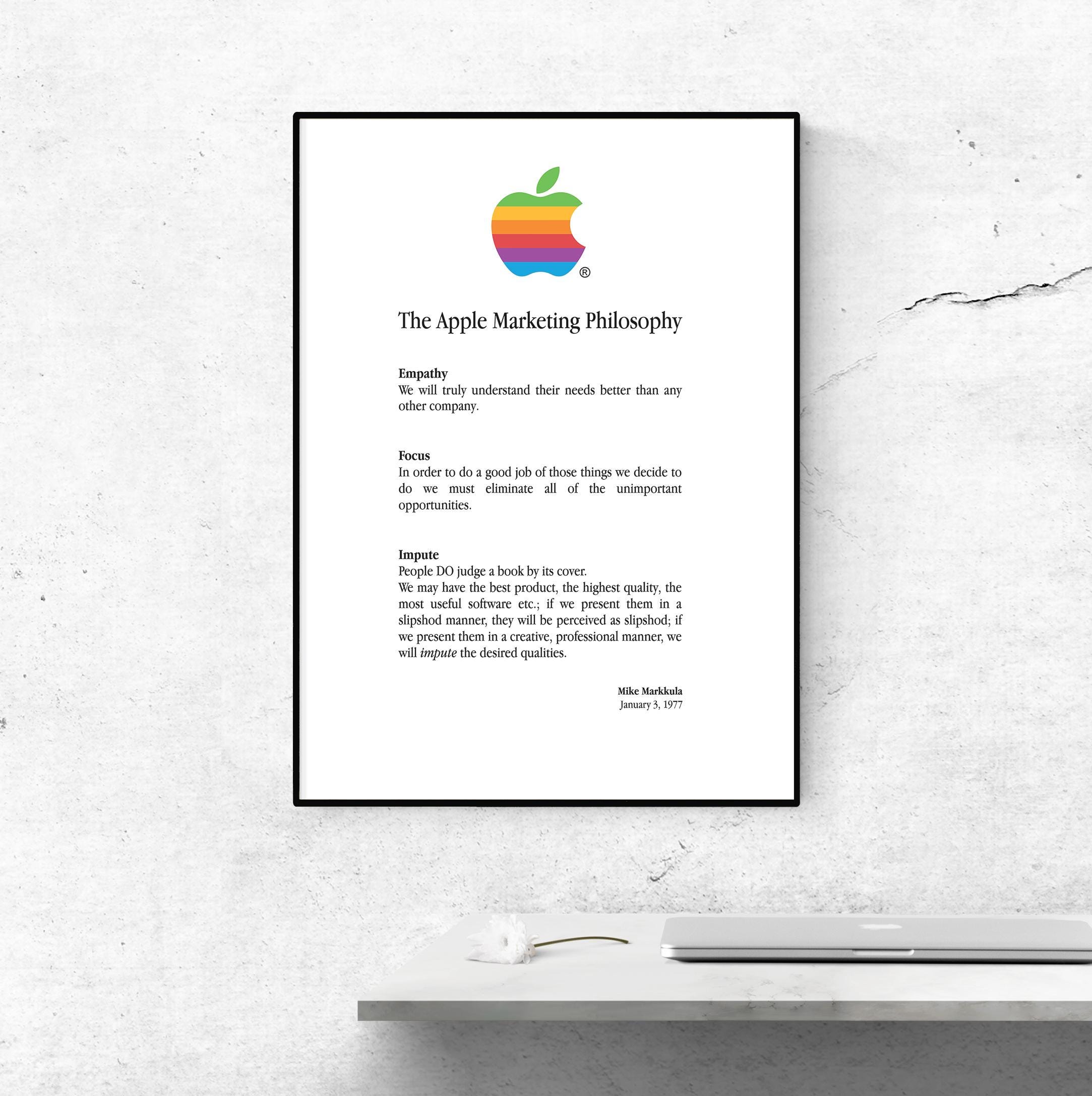
In the Biography of Steve Jobs , Apple 's first investor and then first head of marketing introduced the core principle of Impute. The idea was to get people to buy, marketers need to induce a set of feelings that make them want to buy.
Thus, marketing is about influencing how people move from perception to feeling. Impute is the opposite of compute. The human mind does not rationally compute all the necessary factors, they perceive many factors all at once, often many that they could not rationally point out and determine, much less influence the decision to purchase.

Defining and Describing Impute Marketing

Impute marketing is the practice of shaping what a product’s presentation causes people to assume about its quality before they experience it.
The expression adapts “Impute,” one of three principles in Mike Markkula’s 1977 Apple Marketing Philosophy , alongside empathy and focus. [1] In this sense, impute means to attribute qualities or causes to something; marketing applies that idea to the judgments people make from packaging, design, copy, advertising, and other signals. [2] The concept is most useful when a product’s perceived credibility, quality, or status may diverge from its underlying performance. [3]
flowchart LR A["Product reality"] --> B["Presentation signals"] B --> C["Audience inference"] C --> D["Perceived quality"] D --> E["Attention and consideration"] E --> F["Experience and evaluation"]

Uses in Context

  • Brand and visual identity: Marketers use the concept to argue that design, packaging, and other visible details signal product quality before direct use. [1]
  • Landing-page critique: A page may be evaluated not only for conversion copy but for “what it’s imputing about your brand before anyone reads a word.” [3]
  • Performance marketing: The concept frames weak results as a possible presentation problem rather than only a targeting, attribution, or media-buying problem. [3]
  • Advertising and creative strategy: A campaign can be judged by whether its execution makes the product appear worth noticing before a viewer clicks or investigates. [4]
  • Product launches: The idea explains why polished presentation can establish trust and expectations before customers have tested the product. [1]

History of Use

Origins

The documented origin of the marketing sense is Mike Markkula’s January 1977 one-page The Apple Marketing Philosophy , which identified empathy, focus, and impute as its three principles. [1] The source describes impute as the idea that people judge a product by its presentation and that quality must be signaled through packaging, design, and every customer impression. [1] Available search results do not establish that Markkula coined the standalone phrase “Impute Marketing” ; they instead show the phrase being used retrospectively to name a marketing application of his principle. [3] [4] [5]

Evolution

  • 1977 — Product philosophy: Markkula’s formulation positioned impute as a general marketing principle: presentation influences judgments about product quality. [1]
  • 2025–2026 — Performance-marketing reinterpretation: Contemporary practitioners connected impute to conversion performance, arguing that execution can cause performance numbers to reflect presentation quality rather than product quality. [3] [5]
  • 2026 — Broader brand-signaling usage: The term was applied to landing pages, pitches, billboards, and other pre-experience signals intended to make an offering appear worth attention. [4] [6]

Best Real-World Examples

  • Apple Marketing Philosophy — Packaging, design, and retail presentation exemplify the original impute principle. [1]
  • FullEnrich Times Square billboard — A minimal billboard was presented as an example of making a product feel attention-worthy before a click. [4]
  • A polished landing page — The example illustrates how page quality can shape assumptions before visitors read the copy. [3]
  • A founder pitch deck — The contrast between a “brilliant pitch” and an outdated-looking presentation shows how format can undermine perceived quality. [4]
  • Apple product presentation — White packaging, keynotes, and retail stores are described as practical expressions of the 1977 philosophy. [1]
  • Performance marketing audit — The proposed audit asks whether advertising execution communicates something false about the product. [5]

Case Studies

Apple’s presentation system. In 1977, Mike Markkula’s Apple Marketing Philosophy defined impute alongside empathy and focus. [1] Its central premise was that customers judge quality through presentation, including packaging, design, and other impressions. [1] Later descriptions connect the principle with Apple’s white boxes, retail stores, and keynote presentations. [1] The case shows impute marketing operating as a coordinated system: individual design decisions reinforce a common inference about quality rather than functioning as decoration alone. [1]
FullEnrich’s minimalist billboard example. A 2026 practitioner account described placing FullEnrich on a Times Square billboard with three words and no call to action, characterizing the choice as “pure impute.” [4] The intended effect was not to explain the product in detail but to make it feel sufficiently notable to deserve attention before an audience clicked or learned more. [4] This illustrates how impute marketing can prioritize status, memorability, and perceived importance over immediate information density. [4]
The performance-marketing reframing. Recent practitioner commentary argues that marketers often focus on CTR, CAC, and ROAS while overlooking the quality signals embedded in execution. [3] The argument is that a strong product can underperform when its landing page, advertising, or presentation makes it appear less capable than it is. [3] A related account says impute helps determine whether performance numbers reflect actual product quality or merely its presentation. [5] This case reframes impute from a brand-design principle into a diagnostic lens for explaining weak conversion performance. [3] [5]

Images


Sources

[1] 2026, Jul 03. geschichte-der-informatik.de . Mike Markkula: The Adult Supervision . Updated: 2026, Oct 04. Generated: 2026, Nov 14. Perplexity API response.

[2] 2025, Nov 22. merriam-webster.com . Definition of IMPUTE . Updated: 2026, Mar 29. Generated: 2026, Nov 14. Perplexity API response.

[3] 2026, Aug 17. linkedin.com . Triple Whale vs Northbeam: Choosing the Right Attribution Tool for ... . Updated: 2026, Sep 21. Generated: 2026, Nov 14. Perplexity API response.

[4] 2026, May 25. linkedin.com . Giuseppe Caputo's Post - LinkedIn . Updated: 2026, Jun 08. Generated: 2026, Nov 14. Perplexity API response.

[5] 2026, Aug 12. linkedin.com . The Dangers of Last-Click Attribution in Marketing Reports . Updated: 2026, Sep 10. Generated: 2026, Nov 14. Perplexity API response.

[6] 2026, Jun 03. linkedin.com . Priya Singh's Post . Updated: 2026, Jun 08. Generated: 2026, Nov 14. Perplexity API response.

[7] 2026, Sep 10. gadgetsnow.indiatimes.com . John Ternus Borrowed From Four Apple CEOs In One Keynote, And ... . Updated: 2026, Nov 01. Generated: 2026, Nov 14. Perplexity API response.

[8] 2026, Jan 01. mnemopack.com . Impute - Definition, Examples & Usage | MnemoPack Dictionary . Updated: 2026, Feb 22. Generated: 2026, Nov 14. Perplexity API response.

[9] 2026, Aug 24. linkedin.com . CPM Doesn't Measure Value of Influencer Partnerships - LinkedIn . Updated: 2026, Sep 21. Generated: 2026, Nov 14. Perplexity API response.

[10] 2026, Jun 04. linkedin.com . In 1997, Apple was facing a major decline. The company was losing ... . Updated: 2026, Jun 20. Generated: 2026, Nov 14. Perplexity API response.