


Microgrid Operations
Microgrid operations manage localized energy networks that can function while connected to the main utility grid or independently during a power disruption.
[1]
[2]
Primary Modes of Operation
- Islanded (Off-Grid) Mode: The microgrid disconnects from the main grid during an outage or disturbance. Battery Energy Storage Systems (BESS) or backup generators instantly form and supply power to the local facility. [2] [3] [5]
- Reconnection Transition: The microgrid detects a stable utility grid, synchronizes frequency and voltage, and safely transitions back to parallel operation. [3]
Core System Components
- Distributed Energy Resources (DERs): Includes on-site renewables (solar PV, wind) and conventional backup generators (diesel or natural gas).
- Energy Storage Systems (BESS): Batteries store excess energy and balance real-time fluctuations between local supply and demand.
Defining and Describing Microgrid Operations
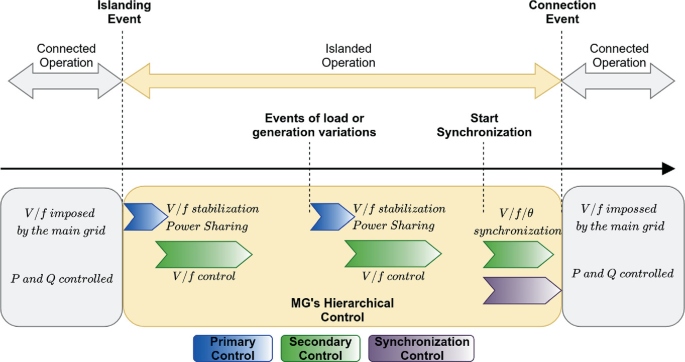
Microgrid operations are the coordinated control of local generation, storage, loads, and grid connections so an electrical system can remain reliable, economical, and resilient in both normal and emergency conditions.
[7]
[8]
A microgrid is a group of interconnected loads and distributed energy resources within defined electrical boundaries that operates as a controllable entity.
[7]
[8]
Microgrid operations apply when the system is connected to the utility grid, intentionally or involuntarily islanded, or transitioning between those states.
[7]
[8]
Core activities include economic dispatch, disturbance detection, islanding, voltage and frequency control, load shedding, restoration, black start, and reconnection.
[7]
[9]
[8]
flowchart LR
A["Utility grid"] --> B["Point of common coupling"]
B --> C["Microgrid controller"]
C --> D["Local generation"]
C --> E["Energy storage"]
C --> F["Controllable loads"]
C --> G["Protection and switchgear"]
G --> H["Islanded operation"]
H --> C
C --> I["Resynchronization"]
I --> B
Uses in Context
- Energy management: The phrase encompasses supervisory energy-management functions that dispatch resources, balance power and energy, and enforce operating constraints. [8]
History of Use
Origins
- The modern microgrid concept is commonly associated with Robert Lasseter’s work, including the 2002 paper Microgrids: A Conceptual Solution , which framed local resources and loads as an integrated system capable of coordinated operation. [12]
- The Consortium for Electric Reliability Technology Solutions, or CERTS, helped move the concept from theory toward demonstration through early-2000s research and pilot activity. [12]
Evolution
- 1990s–2002 — Conceptual framework: Research on distributed generation developed the idea of coordinated local energy systems, with Lasseter’s work articulating microgrids as a distinct operational concept. [12]
- Early 2000s–2005 — Demonstration: CERTS and related pilot projects explored coordinated control, intentional islanding, and improved reliability in practical distribution systems. [12]
Best Real-World Examples
- CERTS Microgrid — an early research and demonstration effort centered on coordinated distributed resources and intentional islanding. [12]
- Microgrid Energy Management Systems — supervisory systems that dispatch resources, balance energy, and coordinate grid-connected and autonomous modes. [8]
- Islanded Microgrid Control — decentralized and distributed control approaches intended to sustain local service during outages. [14]
- Black-Start Microgrid Operation — operational procedures for restarting local generation and sequentially restoring a microgrid without utility support. [9]
- Hybrid Renewable Microgrids — systems combining multiple energy sources and operating in grid-connected or islanded modes. [11]
- South African Load-Shedding Microgrids — hybrid systems using generation, storage, controllable loads, and hierarchical control to maintain service during utility interruptions. [13]
Case Studies
CERTS and the emergence of coordinated microgrid control. The CERTS research effort represented an early transition from the idea of distributed generation toward an operational architecture in which local resources and loads could function as one system.
[12]
Its significance was not simply the installation of additional generation: the work focused on coordinated controls, seamless separation from the utility grid, and autonomous operation after a disturbance.
[12]
This helped establish the operational vocabulary still used today—grid-connected operation, islanding, local balancing, and reconnection.
[7]
[12]
Hierarchical control and resilient operation. Contemporary microgrid research separates operational responsibilities across control layers: fast local controls stabilize voltage and frequency, while supervisory energy-management systems dispatch resources and coordinate constraints.
[8]
[13]
This architecture allows a microgrid to combine solar photovoltaic generation, storage, conventional generation, and controllable loads while preserving a transition path between normal and islanded operation.
[8]
[13]
The case demonstrates that microgrid operations are a continuing control problem rather than a single emergency switch: the system must manage dispatch, protection, load priorities, restoration, and reconnection as a sequence of coordinated decisions.
[9]
[8]
Hybrid microgrids during unreliable grid supply. A South African case described in a 2026 systematic review involves a 5 MW hybrid microgrid combining combined heat and power, solar photovoltaic generation, diesel backup, and a microgrid controller.
[13]
Reported implementations in comparable load-shedding contexts achieved 95–100% availability while reducing diesel consumption by 23–37% and operating costs by 18–28%.
[13]
The example shows how microgrid operations can connect resilience goals with economic optimization: the controller does not merely keep the lights on, but selects among generation, storage, and load-management options according to system conditions.
[8]
[13]
Sources
[8] Resilience of Microgrids to Extreme Weather Events: A Bibliometric Analysis and Review of Control Strategies (2016–2025)
[11] Cost-effective and sustainable operation of microgrids using Improved Whale Optimization Algorithm
[12] Microgrids: A Conceptual Solution Robert H. Lasseter, Paolo Piagi, University of Wisconsin
[13] A Systematic Review of Hierarchical Control Frameworks in Resilient Microgrids: South Africa Focus