


Private Equity
Defining and Describing Private Equity
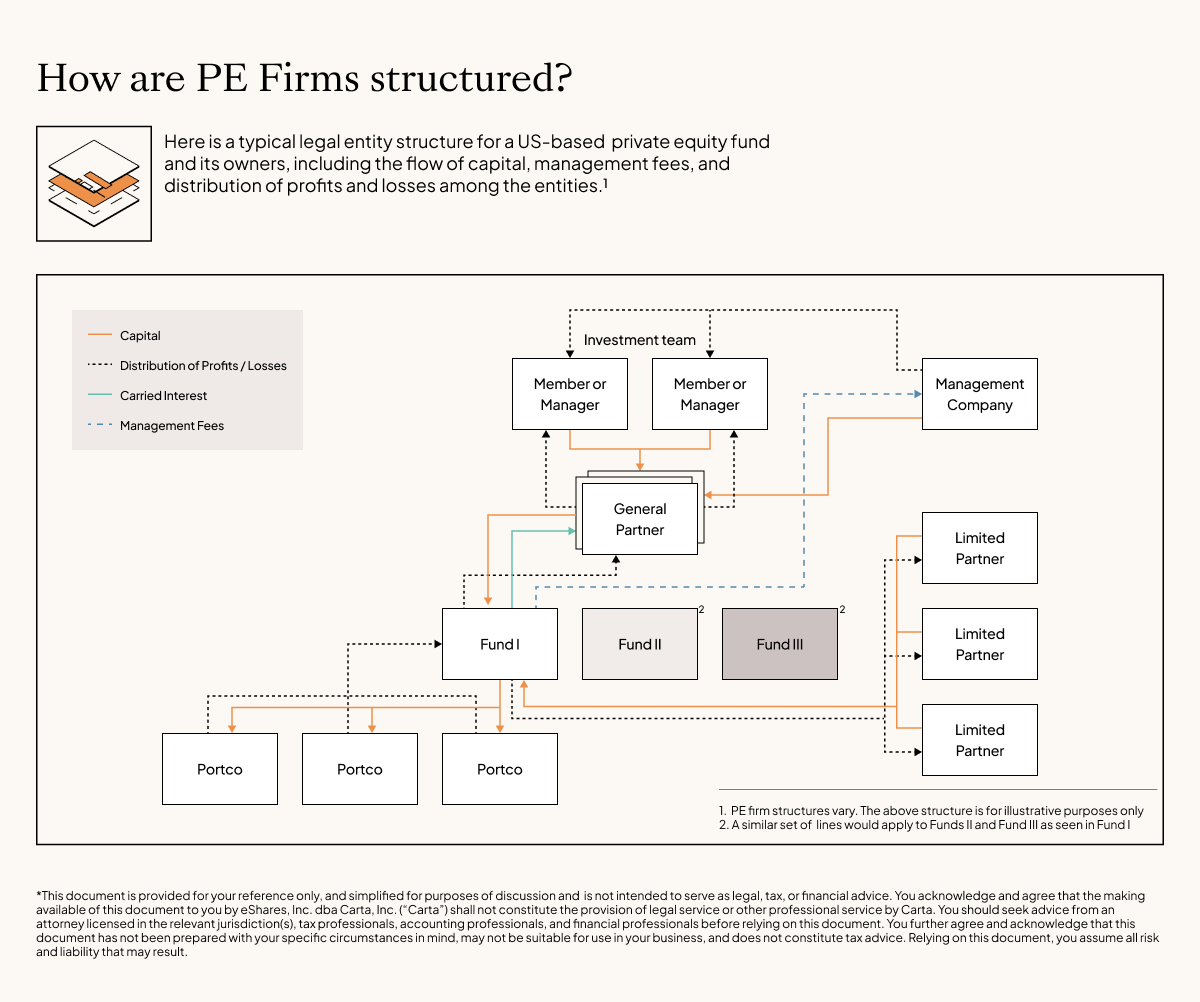
- Private equity is capital invested in privately held or taken-private companies, typically by a fund seeking meaningful influence, operational change, and a profitable exit.
- In startup and innovation consulting, the term usually refers to professional investment firms that raise pooled capital, acquire stakes in companies, and work to increase their value through growth, governance, technology adoption, operational improvement, or restructuring. [1] [2] It applies most directly to mature, established businesses rather than ordinary startup fundraising, although growth-equity investors may back later-stage startups. [2] Innovation consultants care because private-equity ownership can reshape product strategy, organizational design, digital transformation priorities, hiring, incentives, and the founder’s control over strategic decisions. [3] [4]
Disambiguation
Primary sense — the innovation-consulting sense
- Typical target: established companies with relatively stable revenue or cash flows, rather than pre-revenue startups whose primary financing need is experimentation. [2]
- Not venture capital: venture capital generally funds young, high-growth companies and accepts substantial technological and market uncertainty; private equity more often buys companies with demonstrated operations and seeks influence or control. [2]
Other senses
1. Private equity as an asset class
- In this usage, the term describes an investment category rather than a specific fund, transaction, or operating playbook. [1]
- For innovation work, this meaning matters when comparing private-market capital with public equity, venture capital, private credit, or corporate investment.
2. Private-equity firm or fund
- A general partner typically manages investments and makes operating or governance decisions, while institutional investors and other limited partners provide much of the fund’s capital. [4]
- In founder conversations, “the PE firm” may therefore mean the investment manager, whereas “the PE fund” means the particular pool of capital that owns the stake.
Etymology and Origin
- The U.S. Small Business Investment Act of 1958 enabled licensed Small Business Investment Companies, helping establish an early pooled-fund structure for investing in and supporting smaller businesses. [7]
- The leveraged buyout became a recognizable standalone strategy during the 1980s, when high-yield debt markets helped finance major transactions and made financial engineering central to the industry’s public identity. [3]
- The label “private equity” increasingly displaced “leveraged buyout” as the industry broadened beyond highly leveraged acquisitions and sought a less debt-centered description. [9]
Adjacent Vocabulary
- Synonyms :
- Buyout capital : emphasizes acquisition and control, especially in an LBO.
- Growth equity : a lower-leverage, expansion-oriented form of private investment aimed at established but rapidly growing companies.
- Private-market equity : a broader label emphasizing ownership in companies not traded publicly.
- Alternative investment : an umbrella term that may include private equity, hedge funds, private credit, real estate, and infrastructure.
-
- Antonyms :
- Public equity : ownership interests traded on a public exchange.
- Bootstrapping : company growth financed primarily through operating revenue and founder resources rather than institutional equity.
- Debt financing : capital supplied as a repayment obligation rather than an ownership stake.
-
- Adjacent terms :
- Growth Equity
- Leveraged Buyout
- Management Buyout
- Private Credit
Usage in Practice
- Goldman Sachs describes the basic category plainly: private equity is “investing in companies that aren’t listed on a public exchange.” [1]
- A comparison from the Oficina Económica de Galicia characterizes private-equity targets as “mature, consolidated companies with stable cash flows.” [2]
- The same source says private-equity investors “typically acquire majority stakes or full control” so they can restructure the company, improve efficiency, and sell it later. [2]
- A Political Quarterly interview calls the leveraged buyout “the industry’s founding mechanism.” [6]
- That interview explains the financing logic as a fund buying a company “using a small portion of its own money and a lot of debt.” [6]
- Golub Capital describes the late-1970s buyout model as an alternative to “the public corporation and to investing in public equity markets.” [4]
- A Legal 500 history summarizes the industry’s evolution “from buyouts to creative capital solutions,” reflecting the expansion from classic LBOs into broader operational and financing strategies. [3]
Common Misuses
- Calling any private startup investment “private equity.” Use venture capital , angel investment , or startup financing when the investor is funding an early-stage company rather than acquiring an established operating business. [2]
- Calling a consulting-led transformation private equity. Use operational improvement , digital transformation , or value-creation program when no ownership investment or acquisition is involved.
Sources
[1] 2026, Sep 18. am.gs.com . What is private equity? . Updated: 2026, Nov 10. Generated: 2026, Nov 13. Perplexity API response.
[2] 2026, Jul 27. oficinaeconomicagalicia.xunta.gal . What is the real difference between Venture Capital (VC) and Private Equity (PE)? - Oficina Económica de Galicia . Updated: 2026, Sep 13. Generated: 2026, Nov 13. Perplexity API response.
[3] 2026, Apr 06. legal500.com . 40 Years Of Private Equity: From Buyouts To Creative Capital ... . Updated: 2026, Nov 09. Generated: 2026, Nov 13. Perplexity API response.
[4] 2026, Apr 20. education.golubcapital.com . The Secular Case for Private Equity | White Paper . Updated: 2026, Oct 27. Generated: 2026, Nov 13. Perplexity API response.
[5] 2026, Oct 16. join1440.com . Private equity deals sometimes come with layoffs. | 1440 . Updated: 2026, Oct 30. Generated: 2026, Nov 13. Perplexity API response.
[6] 2026, Aug 04. politicalquarterly.org.uk . “If you Delivered Public Services in a way That Truly Works for ... . Updated: 2026, Oct 23. Generated: 2026, Nov 13. Perplexity API response.
[7] 2026, Sep 21. im.natixis.com . Private equity | Natixis Investment Managers . Updated: 2026, Nov 02. Generated: 2026, Nov 13. Perplexity API response.
[8] 2026, Mar 20. scribd.com . en-wikipedia-org-wiki-History_of_private_equity_and_venture_capital . Generated: 2026, Nov 13. Perplexity API response.
[9] 2026, May 19. theedgemalaysia.com . Opinion: ‘Private equity' cries out for a rebranding . Updated: 2026, Nov 02. Generated: 2026, Nov 13. Perplexity API response.
[10] 2026, Oct 16. join1440.com . Private equity firms often use leveraged buyouts to acquire… . Updated: 2026, Oct 30. Generated: 2026, Nov 13. Perplexity API response.