Usability Testing

Defining and Describing Usability Testing

Usability testing reveals what people actually do when they try to accomplish realistic goals with a product.
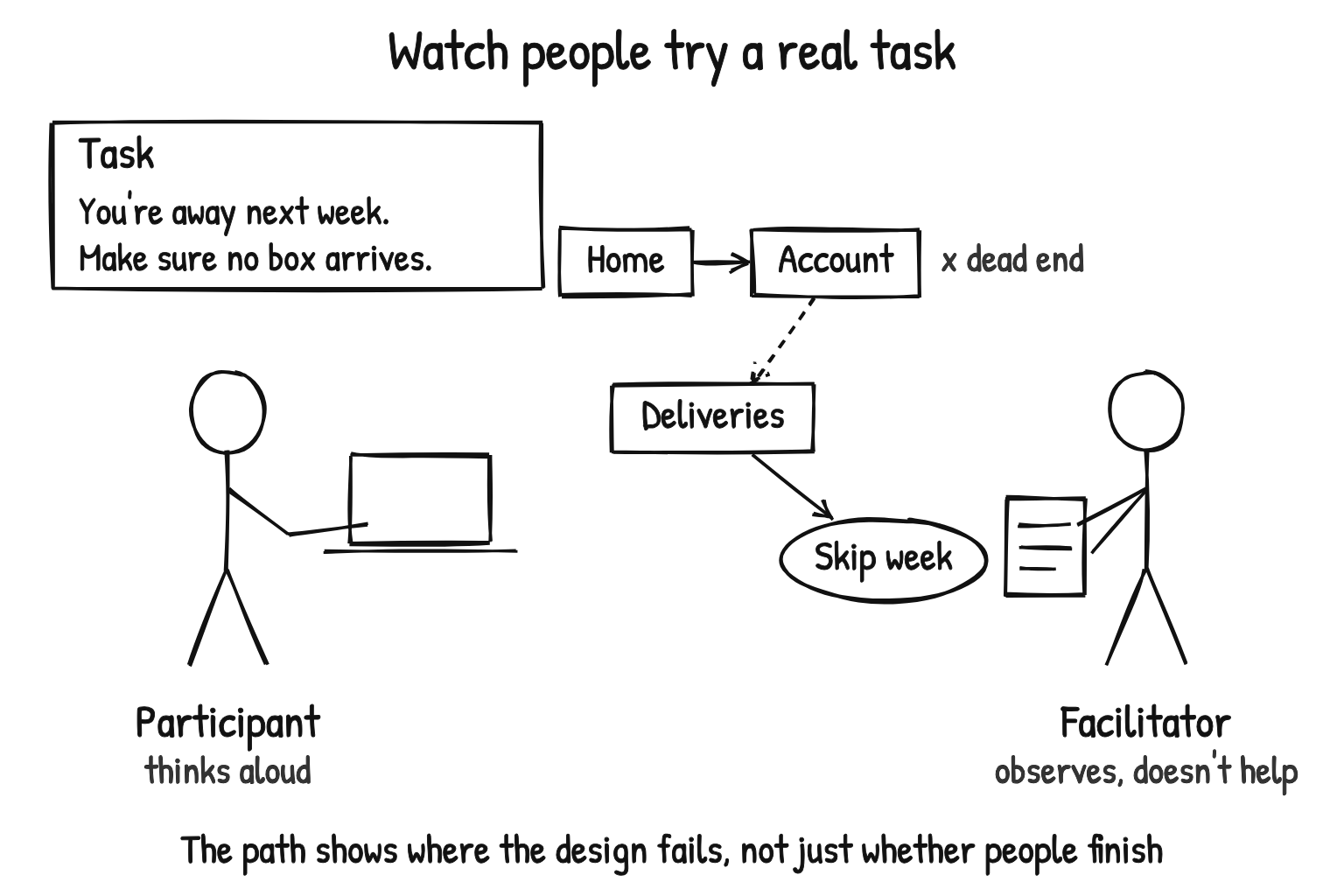
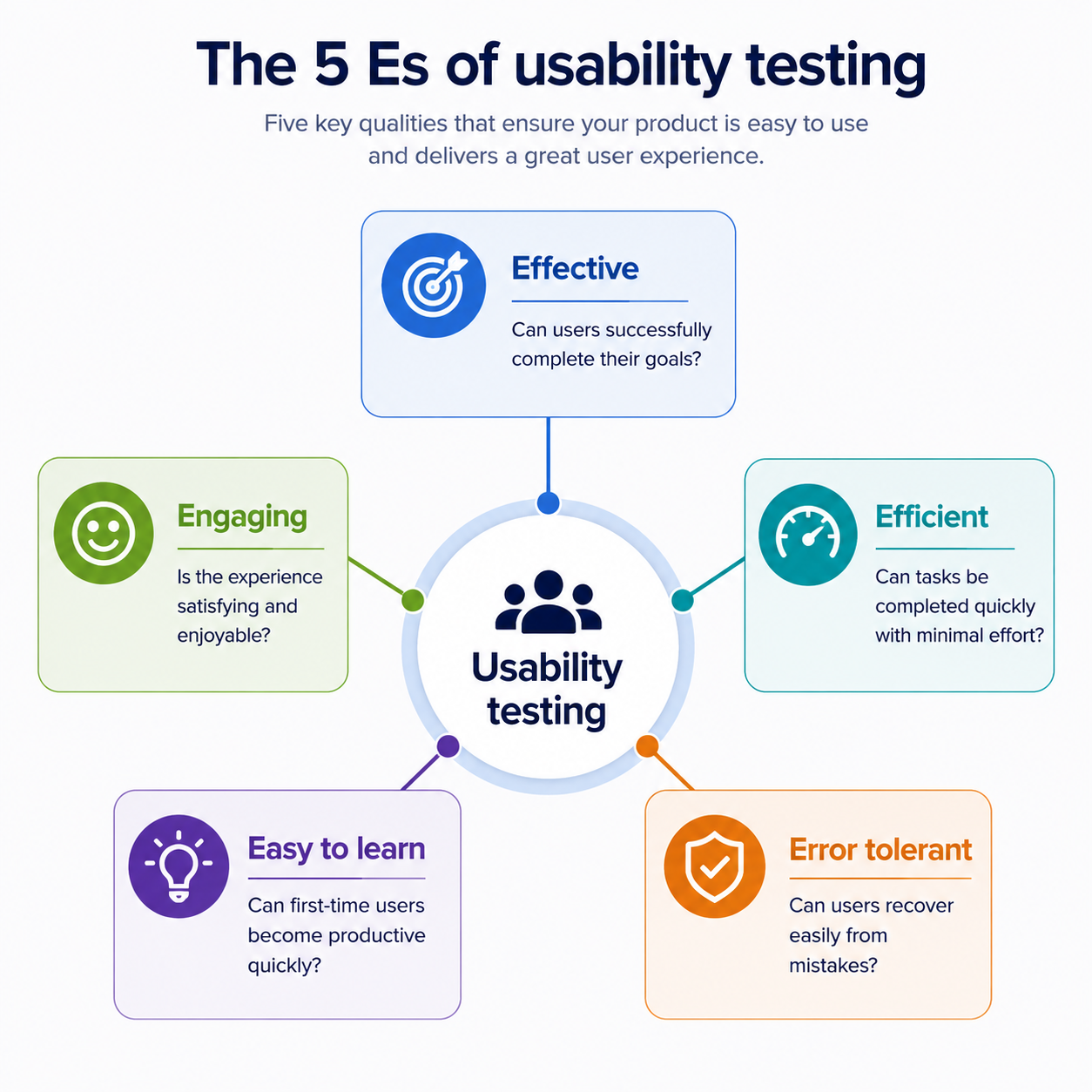
Usability testing is an empirical research method in which representative users attempt realistic tasks while a facilitator observes their behavior, difficulties, errors, and completion outcomes. [1] [2] It applies to websites, applications, software, physical products, and services, especially when teams need evidence about whether a design works for specified users in a defined context. [1] [3] Under ISO 9241-11, usability concerns whether users achieve specified goals with effectiveness, efficiency, and satisfaction. [1] [3]
flowchart LR A["Define users and context"] --> B["Create realistic tasks"] B --> C["Observe task performance"] C --> D["Record behavior and measures"] D --> E["Identify usability problems"] E --> F["Improve and retest"]

Uses in Context

  • Product Design : Teams observe target users interacting with prototypes or finished products to identify confusing flows, navigation problems, and unmet expectations. [2] [4]
  • Software Development : Researchers assess whether users can complete representative workflows, recording task success, time, errors, and satisfaction. [3] [5]
  • Formative research: A test is used diagnostically to “find and understand problems” so that a design can be improved. [2]
  • Summative evaluation: A test measures how well a product accomplishes its intended goals, often using quantitative benchmarks such as completion rates and time on task. [6] [2]
  • Accessibility and inclusion: Testing with people who have relevant disabilities or assistive-technology needs can expose barriers that conventional testing misses. [4]
  • Research communication: The phrase often distinguishes observed behavior from stated preference: practitioners emphasize learning from “what participants do, not what they say they would do.” [2]

History of Use

Origins

Usability testing emerged from human–computer interaction and human-factors research rather than from a single modern technology company. Its intellectual basis lies in evaluating systems through representative users, realistic tasks, and observable performance; later practitioner frameworks formalized the distinction between diagnostic formative testing and measurement-oriented summative testing. [6] [1] Clayton Lewis is associated with introducing think-aloud usability methods at IBM in the early 1980s, while Jakob Nielsen helped popularize the approach among practitioners. [7]

Evolution

  • Early 1980s: Clayton Lewis applied the think-aloud protocol to usability work at IBM, enabling researchers to capture users’ verbalized reasoning while they performed tasks. [7]
  • 1990s: Usability practice increasingly separated formative evaluation, intended to discover and fix problems, from summative evaluation, intended to measure performance against goals. [6]
  • 2010s–2020s: Remote, unmoderated, prototype-based, and quantitative testing expanded the method beyond laboratory studies, while ISO 9241-11 continued to frame evaluation around effectiveness, efficiency, satisfaction, users, goals, and context. [1] [3] [2]

Best Real-World Examples

  • Nielsen Norman Group — helped popularize practitioner-oriented usability testing and the use of small, iterative studies in product design. [7]
  • IBM — served as an early institutional setting for Clayton Lewis’s think-aloud usability work in the 1980s. [7]
  • ISO 9241-11 — provides the widely used effectiveness, efficiency, and satisfaction framework for defining usability. [1] [3]
  • System Usability Scale — exemplifies the use of standardized questionnaires to quantify perceived usability after interaction. [7]
  • Figma — represents the prototype-centered workflow in which interfaces can be tested before implementation; prototype testing is commonly used to identify design problems early. [1] [2]
  • Mozilla Firefox — exemplifies an open-source product category where usability studies can inform navigation, onboarding, and accessibility improvements. [4]
  • UserTesting — represents the commercial remote-testing model, in which organizations recruit target users and observe task attempts outside a traditional laboratory. [4] [8]

Case Studies

IBM and think-aloud testing. In the early 1980s, Clayton Lewis developed think-aloud applications for usability work at IBM, asking users to verbalize their reasoning while completing tasks. [7] The method connected observable behavior with users’ moment-to-moment interpretations, helping researchers diagnose not only that an error occurred but why the interface produced it. [7] Its broader lesson is that usability testing is most valuable when observation is structured around realistic activity rather than post hoc opinion.
Formative versus summative evaluation. Contemporary usability practice distinguishes formative testing from summative testing: formative studies diagnose problems and guide redesign, whereas summative studies estimate how effectively and efficiently a product supports its goals. [6] [2] A team might therefore run short prototype sessions to discover navigation failures, then conduct a later benchmark study using task success, completion time, errors, and satisfaction. [3] [2] [5] This progression shows that usability testing is not one fixed procedure but a family of methods selected according to the decision the team must make.
Remote and quantitative testing. Modern usability testing frequently combines moderated or unmoderated remote sessions with behavioral metrics and standardized satisfaction measures. [3] [2] [4] Researchers can recruit participants who match the target audience, assign realistic scenarios, observe points of hesitation or failure, and compare results across designs or releases. [2] [4] The shift demonstrates how the concept has expanded from laboratory diagnosis into an iterative product-development practice while retaining its central commitment to evidence from users’ actual task performance.

Images


Sources

[1] 2026, Oct 10. next-levels.de . Usability test: definition, methods & process . Updated: 2026, Nov 01. Generated: 2026, Nov 14. Perplexity API response.

[2] 2026, Oct 30. ui-patterns.com . Usability Testing: Methods, Example Tasks and How Many Users . Updated: 2026, Nov 13. Generated: 2026, Nov 14. Perplexity API response.

[3] 2026, Nov 08. uxia.app . Software Usability Testing: Methods, Metrics and Workflow | Uxia . Updated: 2026, Nov 13. Generated: 2026, Nov 14. Perplexity API response.

[4] 2026, Nov 11. virtuosoqa.com . Usability Testing: Types, Process, and Best Practices . Updated: 2026, Nov 06. Generated: 2026, Nov 14. Perplexity API response.

[5] 2026, Oct 06. mutqansoft.sa . Usability Testing — Tasks, Participants, Think-Aloud and Measures . Updated: 2026, Oct 15. Generated: 2026, Nov 14. Perplexity API response.

[6] 2026, Jul 01. onlinelibrary.wiley.com . Unraveling Usability: An In‐Depth Framework of Constructs ... . Updated: 2026, Oct 29. Generated: 2026, Nov 14. Perplexity API response.

[7] 2026, Jun 01. buildwithaitoday.com . What Usability Testing Actually Measures - Build with AI Today . Updated: 2026, Oct 20. Generated: 2026, Nov 14. Perplexity API response.

[8] 2026, Sep 28. netguru.com . Usability testing: A practitioner's guide to running it right . Updated: 2026, Nov 10. Generated: 2026, Nov 14. Perplexity API response.

[9] 2026, Nov 11. scribd.com . Inte Iso Iec 9241 210 2019 | PDF . Generated: 2026, Nov 14. Perplexity API response.

[10] 2026, Jul 22. ficilcom.jp . What Is Usability? Evaluation and Improvement | Xtrategy . Updated: 2026, Oct 13. Generated: 2026, Nov 14. Perplexity API response.