


Antifragile
Antifragile
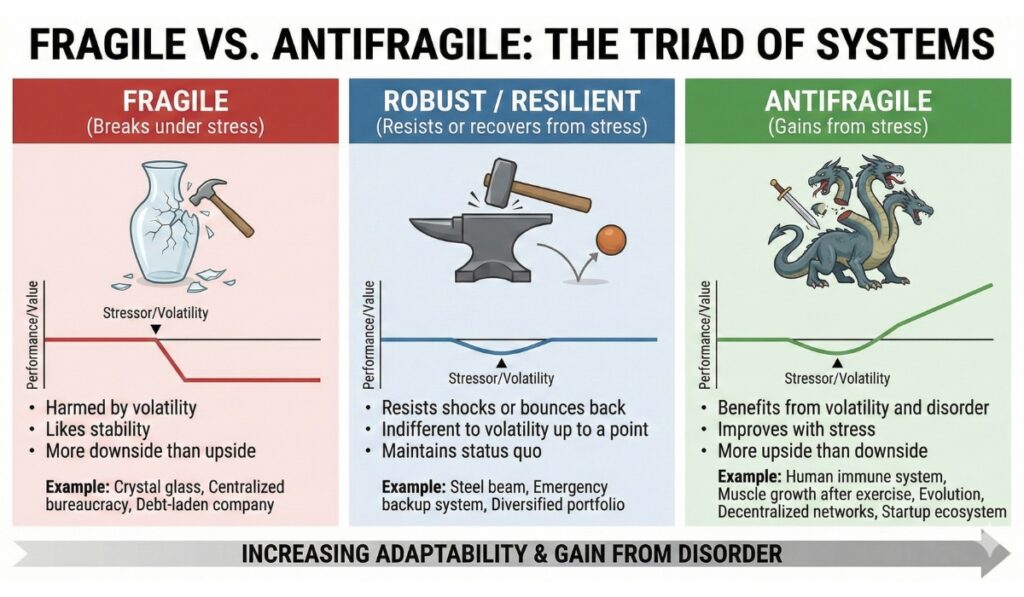
A foundational book on systems design that flips conventional risk management on its head: rather than merely resisting shocks, antifragile systems improve from volatility.
This source is a book—[Antifragile: Things That Gain from Disorder][1]—by philosopher and statistician Nassim Nicholas Taleb, published in 2012 as a direct theoretical response to his earlier The Black Swan (2007). [1] Consultants return to it as a conceptual anchor for rethinking organizational resilience, product strategy, and decision-making under uncertainty: it reframes randomness and disorder not as problems to be solved, but as sources of competitive advantage when systems are designed correctly.
Type and Format
Type: This source is a book.
Format details: Published by Random House in 2012; 519 pages in the first edition. The work has been reprinted multiple times and translated into numerous languages, establishing itself as a canonical text in risk management and innovation practice.
The People Behind It
- Nassim Nicholas Taleb — philosopher, statistician, and risk analyst. [3][5] Author of The Black Swan (2007), which introduced the concept of rare, unpredictable outlier events that shape the world; Antifragile (2012) followed as his theoretical response to building systems resilient to such shocks. He has worked in quantitative finance and is affiliated with the University of Massachusetts Amherst as Distinguished Professor of Risk Engineering. His signature contribution is the formal distinction between fragility (breaks under stress), robustness (resists stress without change), and antifragility (improves under stress).[4]
Catalog of Notable Works
The book develops its central thesis across several major movements:
- The Triad: Fragility, Robustness, Antifragility — Taleb establishes the three categories of system responses to shocks. Fragile systems suffer lethal damage; robust systems withstand but do not evolve; antifragile systems gain from disorder and emerge stronger. [4]
- Things That Gain from Disorder — The core principle: "Some things benefit from shocks; they thrive and grow when exposed to volatility, randomness, disorder, and stressors and love adventure, risk, and uncertainty."[1] Unlike resilience (which merely recovers), antifragility means positive transformation through stress.
- Optionality and Asymmetric Payoffs — Taleb argues that antifragile systems are built on optionality—the ability to benefit from upside while limiting downside. Anything with more upside than downside from random events embodies this principle. [1]
- Via Negativa (The Power of Subtraction) — Rather than adding complexity, antifragile organizations thrive by removing unnecessary elements. "When in a hurry, anything unnecessary is harmful and must be abandoned."[2] Simplify rather than standardize.
- Skin in the Game — Taleb emphasizes that antifragility requires decision-makers to have personal exposure to the consequences of their choices—a structural incentive for building robust systems.
- Trial and Error in Nature and Business — Antifragile systems leverage systematic experimentation. Natural selection demonstrates this principle: organisms that survive stressors reproduce and strengthen the population. [5]
- Small Stressors and Avoiding Catastrophic Failure — "Antifragile systems break a little all the time but evolve as a result, becoming less prone to catastrophic failure."[4] Regular small shocks inoculate against larger ones.
Why It Matters to Innovators
- Reframes risk as opportunity. Conventional strategic planning treats volatility as a problem to manage or hedge. Taleb flips this: uncertainty and disorder become sources of competitive advantage when systems are designed for optionality rather than prediction. This shifts innovation culture from "forecast and execute" to "experiment and adapt." Minimum Viable Product
- Provides a diagnostic framework for organizational fragility. The fragility-robustness-antifragility spectrum offers a clear vocabulary for auditing whether processes, products, and teams actually improve under stress or merely survive it. Amazon's "two-pizza teams" and tolerance for failures (e.g., Fire Phone treated as "tuition") exemplify antifragile design; legacy systems with no failover exemplify fragility.[3]
- Legitimizes small failures and iteration as core strategy. Rather than avoiding errors, antifragile thinking treats pilot programs, scenario planning, and deliberate redundancy not as waste but as insurance and learning mechanisms—aligning with Lean Startup and Agile Development but with deeper philosophical grounding in complexity theory.
- Connects uncertainty to product and market design. Antifragility explains why products and business models that build in flexibility and user feedback loops outperform those locked into rigid forecasts. It underpins customer discovery, option value in platform design, and why decentralized decision-making often outperforms centralized planning under uncertainty.
- Offers a counter-narrative to "resilience." While resilience aims to bounce back to a prior state, antifragility aims to evolve and strengthen. This distinction is crucial for innovators: the goal is not recovery but transformation. [5]
Best Starting Points
- Antifragile: Things That Gain from Disorder (full book) — Start with the opening chapters (1–3) which lay out the fragile-robust-antifragile triad and the principle of optionality; these establish the mental model everything else rests on.
- MIT Sloan: "The Antifragile Entrepreneurial Mindset: An Introduction" — A concise distillation of how Taleb's theory applies to startup and innovation contexts; useful for practitioners who need the framework without the 500-page treatise.
- The Protecht Group: "Anti-Fragile Organisations Explained" — A practitioner-focused guide showing how to identify antifragile traits in teams and processes, with Amazon as a worked example; bridges theory to operational design.
Adjacent Sources
- Nassim Nicholas Taleb — His other books The Black Swan (2007) and Skin in the Game (2018) expand on correlated themes in risk, probability, and decision-making incentives.
- Lean Startup — Shares Taleb's embrace of iteration and experimentation over prediction; antifragility provides the deeper risk-theoretic justification for the Build-Measure-Learn loop.
- Optionality — Core to antifragile thinking; systems designed for multiple strategic branches outperform those locked into single paths.
- Antifragility in Organizational Design — The application of Taleb's framework to team structure, decision rights, and redundancy in production systems.
- Clayton Christensen, Disruption Theory — Complementary lens: while Christensen explains why incumbent firms fail when markets shift, Taleb explains how to design systems that improve because markets shift.
Sources
[1]: The Antifragile Entrepreneurial Mindset: An Introduction
[2]: Antifragile Businesses: Transforming Uncertainty and Change into ...
[3]: Anti-Fragile Organisations Explained - The Protecht Group
[4]: Agile is not enough! Be Anti-FrAgile - ProjectManagement.com
[5]: Antifragility, Adaptability, and Enterprise Risk Management