


Diffusion Of Innovations
Originally published in 1962, the book is still a classic and is on its 5th edition.
Diffusion of Innovations
A foundational 1962 book by communication researcher Everett Rogers that provides the definitive framework for understanding how new ideas, practices, and technologies spread through social systems—essential mental scaffolding for any innovation consultant mapping adoption curves and change resistance.
This is a book, authored by [Everett M. Rogers][1] and first published in 1962. Rogers built on prior diffusion research across sociology, anthropology, and rural studies to synthesize a unified theory explaining why some innovations spread rapidly while others stall or fail entirely. [The work has become so influential that Rogers is credited with defining "the foundation for the whole field of innovation"][5]—consultants and product teams return to it repeatedly to diagnose adoption barriers, segment adopter populations, and design change-management strategies.
Type and Format
Type: This source is a book.
Format details:
- Publisher: Free Press (London and New York, USA)[7]
- Year of first publication: 1962[1]
- Notable editions: A second edition was published with co-author F. Floyd Shoemaker[7]; the work has gone through multiple subsequent editions that have expanded and refined the theory over decades.
- Length: [Canonical audio summary runs approximately 4–5 hours of lecture material][5], suggesting the book is substantial; the exact page count varies by edition.
Where it lives:
- Google Books — Diffusion of Innovations (canonical searchable edition)
- Amazon — Diffusion of Innovations (common retail link cited in podcast summaries)
The People Behind It
- Everett M. Rogers (1931–2004) — communication scholar who spent his career studying how innovations diffuse across social systems. [Rogers built the Diffusion of Innovations theory partly on historical diffusion research spanning multiple disciplines][1], drawing on prior work from rural sociology (the Ryan and Gross corn-adoption study from 1943) and other fields to create a general framework[1].
- Co-author F. Floyd Shoemaker — collaborated with Rogers on the second edition, helping refine and expand the theoretical framework[7].
- Influence on the field: [Rogers's work became so dominant that it effectively established the intellectual foundation for diffusion research across business, public health, technology adoption, and organizational change][5].
Catalog of Notable Works
Since this source IS a book rather than a channel or publication that produces ongoing work, the chapters and major arguments constitute the catalog:
- Chapter on the Five Stages of the Innovation-Decision Process — Knowledge, Persuasion, Decision, Implementation, and Confirmation/Continuation [1]. These stages map the individual journey from first awareness through sustained use, including the critical role of confirmation in preventing cognitive dissonance and adoption reversal.
- Perceived Attributes of Innovation (Five Dimensions) — Relative advantage, Complexity, Compatibility, Observability, and Trialability [3]. Rogers identified these as the primary levers influencing adoption speed; innovations scoring high on relative advantage and low on complexity diffuse faster.
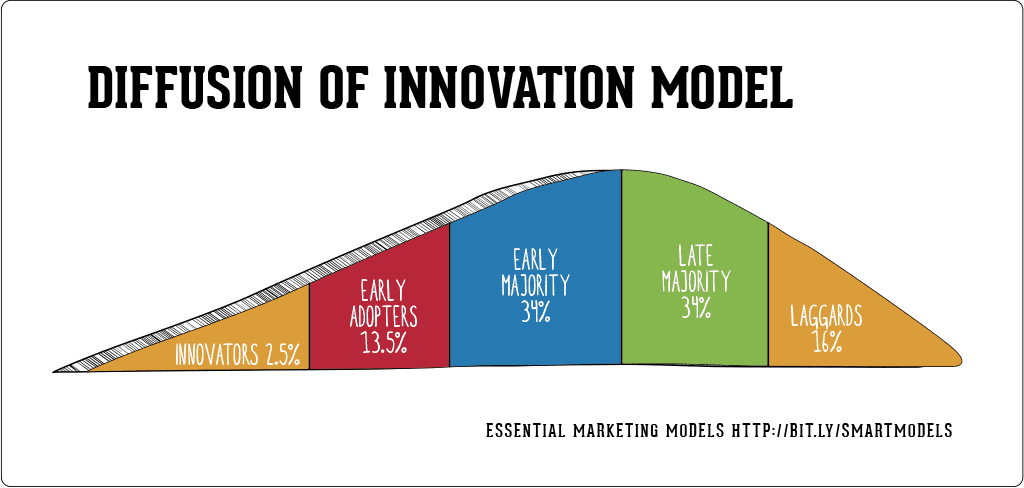
- The Adopter Categories (S-Curve Distribution) — Innovators, Early Adopters, Early Majority, Late Majority, and Laggards [1]. Rogers argued that populations adopt innovations in a mathematically consistent sigmoid (S-shaped) pattern, allowing practitioners to segment strategies by adopter type.
- Communication Channels and Social Systems — The mechanism by which information flows through mass media (broad reach, low interpersonal credibility) versus interpersonal networks (slower reach, high credibility) [1]. Rogers emphasized that diffusion cannot occur without established communication pathways.
- Organizational Innovation Decisions — Collective vs. Authority decisions [1]. Rogers distinguished between innovations adopted by broad organizational consensus versus those imposed by leadership fiat, predicting different adoption trajectories.
- Change Agents and Opinion Leaders — The critical intermediary roles that accelerate or impede adoption [2]. Rogers showed that success depends on change agents' effort in contacting clients, client orientation (rather than agency self-interest), and alignment with clients' actual needs.
- The Pro-Innovation Bias and Individual-Blame Bias — [Critical reflexive analysis of how diffusion research itself can perpetuate flawed assumptions][5]—for example, blaming non-adopters for irrationality rather than examining whether an innovation truly fits a user's context.
Why It Matters to Innovators
- Diagnostic framework for adoption stalls: The five perceived attributes (relative advantage, complexity, compatibility, observability, trialability) give consultants a concrete checklist to diagnose why an innovation isn't spreading. A high-complexity tool with low trialability will diffuse slowly regardless of superiority; the framework makes this visible and actionable[3].
- Segmentation and timing strategy: The adopter categories (innovators → early adopters → early majority → late majority → laggards) teach practitioners that adoption is not binary but staged, and that different cohorts require fundamentally different messaging and support. Early adopters are often "respected in the organisation" and their acceptance will steer the next group, the Early Majority [6]—this insight enables targeted change management.
- Distinction between communication channels and credibility: Rogers demonstrates that mass media generates awareness efficiently but interpersonal networks drive actual behavior change[1]. This reframes go-to-market strategy: for high-stakes or complex adoptions, relying on advertising alone will fail; opinion leaders and peer demonstration matter more[2].
- Organizational decision modes and resistance: Rogers distinguishes between collective innovation decisions (broad consensus) and authority decisions (leadership decree) [1]. This illuminates why top-down mandates for new tools often produce surface compliance without deep adoption, whereas bottom-up consensus builds faster internalization—connecting to Organizational Change Management
- Time as a structural variable: Rogers emphasizes that "passage of time is necessary for innovations to be adopted; they are rarely adopted instantaneously" [1]. The classic example—hybrid corn adoption took over ten years—teaches consultants to expect diffusion as a multi-year phenomenon rather than an event, resetting unrealistic deployment timelines and preventing premature declarations of failure.
Best Starting Points
- Diffusion of Innovations — Full Text (Google Books) — Start here if you want primary source authority; read the introduction and the chapter on perceived attributes first to ground yourself in the core framework.
- — Most accessible entry point; the ~4-hour audio summary distills Rogers's key concepts (adopter categories, stages, attributes, communication channels, and critical biases) without requiring a full textbook read.
- Diffusion of Innovations Theory Explained — SM Insight — Clear 1,500-word visual explainer that walks through the core model with modern examples (e.g., fidget spinners), ideal for rapid team onboarding or stakeholder briefings.
- The Five Perceived Attributes of Innovations (RealKM summary) — Focused, practical breakdown of the five attributes (relative advantage, complexity, compatibility, observability, trialability) with emphasis on how each shapes adoption speed; use this to run a diagnostic on a specific product or service you're trying to diffuse.
Adjacent Sources
- Organizational Change Management — Rogers's distinction between collective and authority innovation decisions directly informs how organizations design adoption strategies; see also change management literature on resistance.
- Early Adopters Opinion Leaders — Rogers's concept of opinion leaders and early adopters as catalysts for diffusion; also relevant: innovator segments and how to identify and mobilize them.
- Product Market Fit — Rogers's "compatibility" attribute (fit to established ways) and "relative advantage" connect to the product-market fit problem; incompatible or non-advantageous innovations fail to diffuse no matter the marketing.
- Technology Adoption Curve — The S-curve distribution and adopter categories are foundational to modern tech adoption models; closely related to Geoffrey Moore's Crossing the Chasm, which extends Rogers for high-tech markets.
- **Everett Rogers — Rogers authored multiple books and papers beyond Diffusion of Innovations; his broader research on organizational innovativeness and rural development extends the theory.
- Change Agents — Rogers emphasizes the critical role of change agents and paraprofessionals in accelerating adoption; this concept is central to modern go-to-market and organizational deployment strategy.
Sources
[1]: Diffusion of innovations - Wikipedia
[2]: Diffusion of Innovations - TheoryHub - Academic theories reviews for ...
[3]: Diffusion of innovations - RealKM
[4]: Diffusion of Innovation Theory Explained - SM Insight
[5]:
[6]: [PDF] The Diffusion of Innovation Experience - HAL-Inria
[7]: [PDF] Everett M. Rogers' – Diffusion of Innovation
[8]: Mapping Rogers' Theory of Diffusion of Innovations to Empathetic ...
[9]: Innovations are not adopted by all individuals in a social system at ...