


Some Simple Economics of AGI
-
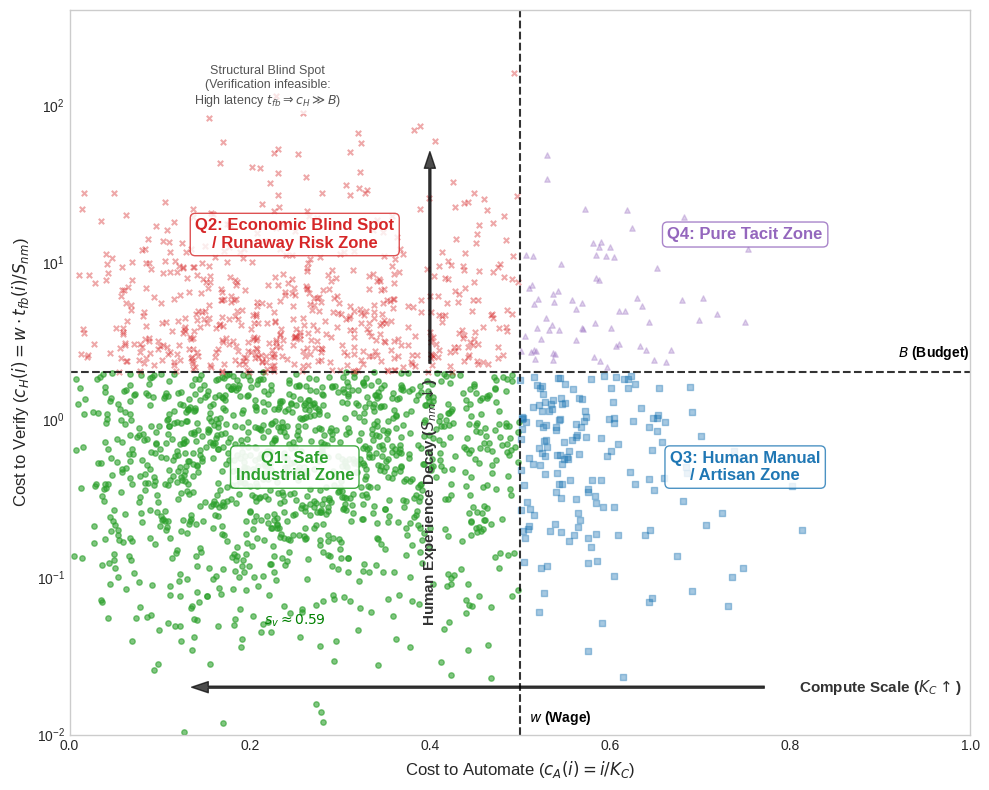
- This source is a research report / academic working paper , not a book or recurring publication. It was written by Christian Catalini of MIT, Xiang Hui of Washington University in St. Louis, and Jane Wu of UCLA. [1] The paper was published as arXiv preprint 2602.20946 in 2026. [1] [3] Innovation consultants return to it because it offers a useful lens for separating technical capability from deployable, economically realizable value. [2] [4]
Type and Format
- Type: This source is a research report.
The People Behind It
- The authors frame the work as an economics analysis of AI deployment rather than an attempt to define the philosophical threshold for AGI. [4]
Catalog of Notable Works
Why It Matters to Innovators
- Verification becomes the scarce resource. The paper argues that the cost of generating plausible outputs is falling, while the cost of determining whether those outputs are correct remains tied to human time, expertise, evidence, and real-world feedback. [4] This shifts strategic attention from raw model capability to ( Agent Accreditation ) infrastructure.
- The “Measurability Gap” explains why capability does not equal adoption. The authors define a widening distance between what AI can economically execute and what people can economically verify. [2] [4] This is a useful diagnostic for products that automate high-stakes, ambiguous, or slow-feedback workflows.
- Automation boundaries should be framed as measurable versus non-measurable. Rather than relying only on the conventional distinction between routine and non-routine work, the paper argues that tasks become economically automatable when their outputs can be measured reliably. [2] This connects directly to Jobs-to-be-Done and Agentic Workflows .
- Agentic scaling can be capped by oversight capacity. As compute expands the frontier of what agents can execute, society’s ability to oversee and verify those actions may become the binding constraint on realized economic value. [2] For innovators, this makes audit trails, evaluation systems, human escalation, and outcome instrumentation part of the core product—not compliance afterthoughts.
- The paper installs a practical investment heuristic: prioritize markets where verification is cheap, frequent, objective, and digitally observable; be cautious where correctness emerges only after long delays or depends on tacit expertise. [2] [4] This helps identify strong candidates for Workflow Automations and distinguish them from superficially attractive but operationally unverifiable use cases.
Best Starting Points
- The Economics of AI: Verification as the New Scarcity — the most accessible explanation of the paper’s central claim: production is becoming cheap, while knowing whether production is correct remains scarce. [4]
- Some Simple Economics of AGI — author research page — a concise statement of the Measurability Gap and the paper’s core economic mechanisms. [2]
- Some Simple Economics of AGI — arXiv record — the canonical scholarly entry point and preprint record. [3]
Adjacent Sources
- Christian Catalini
- Xiang Hui
- Jane Wu
- AI's Use of Knowledge in Society
Sources
[1] 2026, Aug 10. ar5iv.labs.arxiv.org . ar5iv.labs.arxiv.org · html · 2602[2602.20946] Some Simple Economics of AGI - ar5iv.labs.arxiv.org . Updated: 2026, Oct 31. Generated: 2026, Nov 09. Perplexity API response.
[2] catalini.com . Some Simple Economics of AGI — Christian Catalini . Updated: 2026, Jul 21. Generated: 2026, Nov 09. Perplexity API response.
[3] 2026, Feb 24. alphaxiv.org . Some Simple Economics of AGI - alphaXiv . Updated: 2026, Nov 06. Generated: 2026, Nov 09. Perplexity API response.
[4] catalini.com . The Economics of AI: Verification as the New Scarcity . Updated: 2026, Oct 03. Generated: 2026, Nov 09. Perplexity API response.
[5] 2026, Feb 25. cliffsnotes.com . Some Simple Economics of AGI (pdf) - CliffsNotes . Updated: 2026, Nov 08. Generated: 2026, Nov 09. Perplexity API response.
[6] catalini.com . Research — Christian Catalini . Updated: 2026, Nov 09. Generated: 2026, Nov 09. Perplexity API response.
[7] 2026, Oct 14. alphaxiv.org . Jane Wu . Updated: 2026, Oct 17. Generated: 2026, Nov 09. Perplexity API response.
[8] ideas.repec.org . Christian Catalini . Updated: 2026, Oct 29. Generated: 2026, Nov 09. Perplexity API response.
[9] 2025, Feb 02. ideas.repec.org . AI's Use of Knowledge in Society . Updated: 2026, Oct 27. Generated: 2026, Nov 09. Perplexity API response.
[10] 2025, Feb 02. ideas.repec.org . Genius on Demand: The Value of Transformative Artificial Intelligence . Updated: 2026, Nov 01. Generated: 2026, Nov 09. Perplexity API response.