Automate processes with powerful AI Agents ✓Build & deploy agents in minutes ✓Seamlessly integrate into your workflows ➤ Start automating today!
Beam AI
Comprehensive Research Profile: Beam AI
Beam AI is an agentic AI platform purpose-built for enterprise automation, with particular emphasis on banking, fintech, and complex business process workflows.
[1kkukr]
[1kkukr]
[1kkukr]
The platform enables organizations to build and deploy autonomous AI agents through natural language interfaces, abstracting away traditional coding complexity while maintaining enterprise-grade reliability, governance, and observability.
[ajk1no]
[ajk1no]
[ajk1no]
As of May 2026, Beam AI operates as a horizontal automation platform competing in the rapidly expanding Agentic AI market, which is projected to grow from $7.5 billion in 2025 to $231.9 billion by 2034—representing a compound annual growth rate of 46.3%.
[aai2aj]
Value Proposition & Features
Beam AI positions itself as an agentic AI platform designed to automate complex, multi-step business processes without requiring traditional software development expertise. The core value proposition centers on the ability to rapidly deploy autonomous agents that can make decisions, coordinate across multiple systems, integrate with enterprise infrastructure, and maintain full governance, auditability, and explainability throughout execution.
[1kkukr]
[ajk1no]
[1kkukr]
Rather than treating AI as a conversational layer, Beam emphasizes AI agents as autonomous workers that integrate into existing workflows, execute tasks with accuracy monitoring, and improve performance through continuous learning.
Core Platform Capabilities
The platform provides several foundational capabilities that distinguish it from legacy workflow automation tools. Beam's natural language agent builder allows users to describe automation requirements in conversational language, with the system responding by generating working agents in real-time, complete with relevant tool integration and execution logic.
[ajk1no]
[ajk1no]
This represents a departure from traditional visual workflow builders by incorporating LLM-based reasoning directly into the agent creation process, enabling non-technical users to construct sophisticated automation without manual node configuration.
The execution layer includes custom code support, allowing engineers to write JavaScript or Python directly within agent flows for precise data transformations, lookups, and calculations without requiring separate API calls or external services.
[ajk1no]
[ajk1no]
[ajk1no]
This hybrid approach—combining AI-driven orchestration with deterministic code execution—addresses a critical operational requirement: certain steps require exact computation and should not be subject to model variance or inference-time non-determinism.
Enterprise workspaces receive comprehensive visibility into credit consumption across all platform levels, enabling cost attribution and budget management at granular scales.
[ajk1no]
[ajk1no]
This becomes essential as organizations scale agent deployment across departments and verticals, requiring chargeback models and resource governance.
Beam implements dynamic execution patterns where agents adjust their execution paths based on real-time results rather than following predetermined step sequences.
[ajk1no]
Agents can automatically retry failed steps, evaluate output accuracy, extend processes based on results, or take alternative routes—capabilities that were previously unavailable in static workflow automation systems.
The platform features condition nodes that support both LLM-powered evaluation and rule-based logic,
[ajk1no]
recognizing that different decision types require different mechanisms. Critical business decisions may require transparent, auditable rule enforcement, while nuanced contextual judgments benefit from language model reasoning.
Key Features in Priority Order
The following represents the most critical capabilities based on platform announcements and user-facing features documented in recent product updates:
Natural language agent creation – Conversational interface that builds executable agents from plain English descriptions, with real-time flow generation and intelligent follow-up questions
[ajk1no]
[ajk1no]
Multi-step workflow orchestration – Agents that decompose goals into executable steps, coordinate across multiple systems, manage error states, and adapt execution based on results
[ajk1no]
[ajk1no]
[ajk1no]
Custom code execution – JavaScript and Python runtime embedded within flows for deterministic data operations without relying on language models
[ajk1no]
[ajk1no]
1500+ pre-built integrations – Connections to major enterprise platforms including Microsoft Business, Apaleo, Google Sheets, GitHub, and Stripe, reducing integration engineering overhead
[ajk1no]
[ajk1no]
Enterprise governance and observability – Workspace-level credit tracking, audit trails per agent action, accuracy scoring per step, and comprehensive logging for compliance requirements
[ajk1no]
[ajk1no]
[nb73la]
Continuous learning and adaptation – Improved algorithms that understand task patterns, optimize tool selection based on historical data, and allow agents to improve performance over time
[ajk1no]
[ajk1no]
[ajk1no]
Dedicated infrastructure – US-based infrastructure deployed natively, providing data residency guarantees and improved performance for North American customers
[ajk1no]
[ajk1no]
Structured data handling – Custom views and workspace-level data tables that aggregate task outputs into queryable interfaces, enabling teams to build applications on top of Beam without external databases
[ajk1no]
[ajk1no]
Screenshots
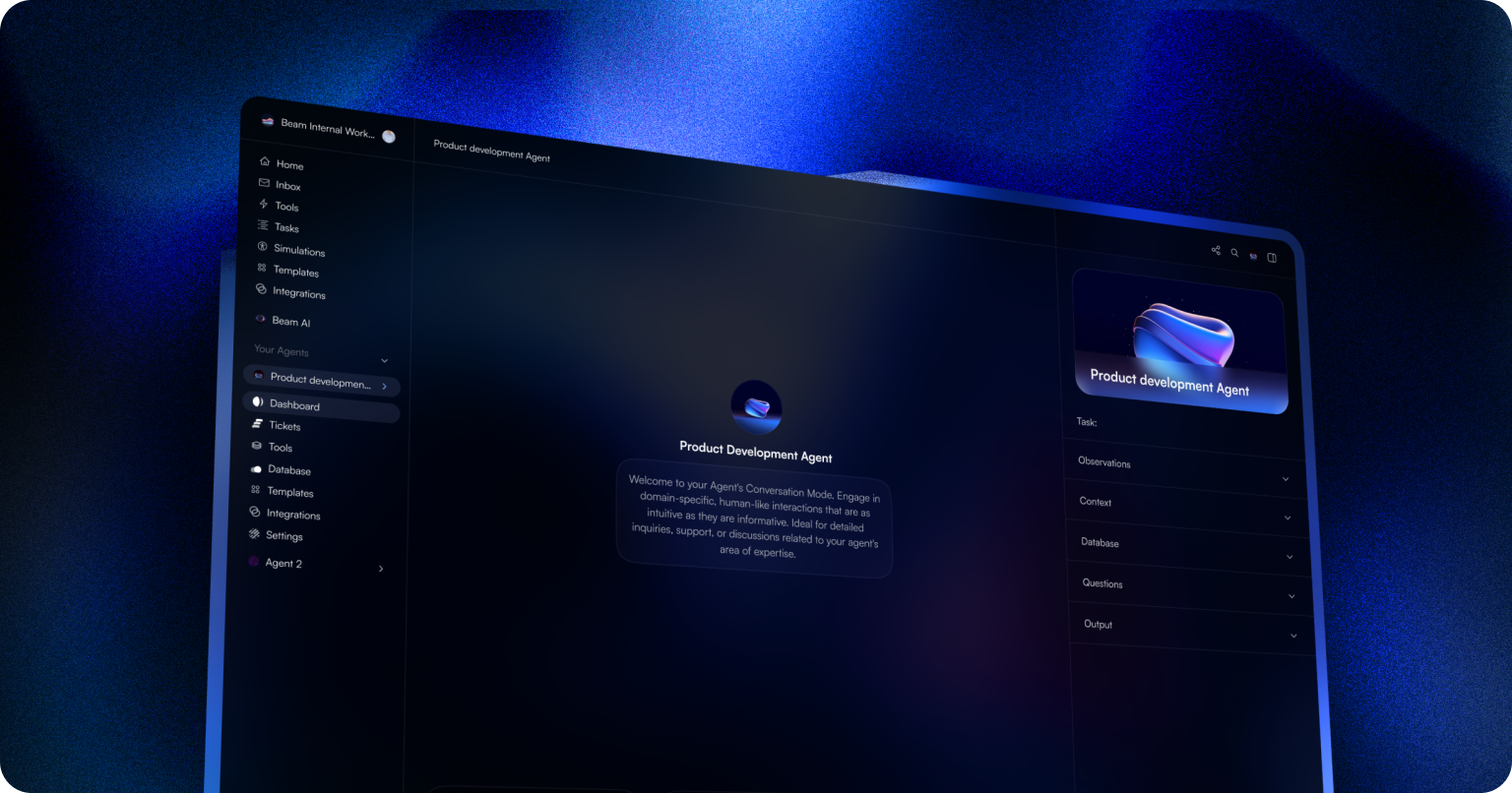
Official screenshots for Beam AI's platform interface are not clearly documented in the provided search results. The platform materials reference flow builders, agent configuration pages, and task dashboards, but specific publicly-available screenshot URLs were not identified in this research.
Product Roadmap & Announcements
As of May 9, 2026, the following product developments and announcements represent Beam AI's recent momentum:
May 2026: Enhanced Flow Validations and Integration Experience – Beam released visual validation feedback highlighting incomplete configurations with contextual tooltips; integration tool outputs can now be passed to downstream steps (previously limited to Prompt tools); task creation now supports running with past executions via dropdown selection; workspace logos auto-fetch from domain configuration; and LLM model selection is now consistent across all platform settings.
[ajk1no]
[ajk1no]
[ajk1no]
May 2026: Code Execution and Custom Data Tables – The Code Execution Node went live, enabling JavaScript and Python execution directly within flows without AI overhead for precise data transformations and calculations.
[ajk1no]
[ajk1no]
[ajk1no]
Simultaneously, Custom Views (Data Tables) functionality launched, allowing creation of workspace-level data tables that aggregate task outputs and support relational queries without requiring external databases.
[ajk1no]
[ajk1no]
May 2026: Improved Agent Learning Algorithms – Beam deployed enhanced pattern recognition for recurring workflows, improved dataset augmentation for agent training, and smarter tool selection based on historical task execution data.
[ajk1no]
[ajk1no]
May 2026: US-Based Infrastructure Launch – Enterprise-grade dedicated US infrastructure now available, providing improved performance and explicit data residency options for North American customers.
[ajk1no]
[ajk1no]
April 2026: Condition Nodes and Dynamic Execution – Implementation of LLM-powered and rule-based conditional branches, supporting multiple conditions with AND/OR logic; agents can now dynamically adjust execution paths instead of following fixed sequences; agents evaluate each step with accuracy scoring before proceeding, automatically retrying failed steps.
[ajk1no]
[ajk1no]
[ajk1no]
March 2026: Agent Setup Improvements – Chat-based agent creation experience refined to prompt users with guiding questions, generating process summaries before flow construction; real-time flow generation with reasoning displayed for each step.
[ajk1no]
[ajk1no]
March 2026: 1500+ New Integration Expansion – Beam added over 1,500 new pre-built integrations across enterprise platforms, with specific callouts for Microsoft Business Integration, Apaleo (hospitality reservations), Google Sheets data range retrieval, and GitHub issue management and pull request operations.
[ajk1no]
[ajk1no]
Recent Developments
May 2026: Microsoft Agent 365 Competitive Response – Beam AI published analysis of Microsoft's launch of Agent 365 (May 1, 2026), a $15/user/month governance control plane for enterprise AI agents.
[nb73la]
The analysis positioned Beam's governance architecture—featuring discovery, data governance via Purview integration, context mapping, and runtime blocking capabilities—as foundational versus bolted-on, noting that 78% of workers use AI agents weekly while most enterprises have zero governance.
[nb73la]
[nb73la]
May 2026: Geopolitical Analysis – China's Manus AI Acquisition Block – Beam published an analysis of China's National Development and Reform Commission blocking Meta's $2 billion acquisition of Manus AI, classifying agentic AI as controlled technology.
[gom19g]
The analysis advised enterprise procurement teams to add "model provenance" to compliance checklists, moving beyond data residency to assess where AI capabilities were developed, under which country's jurisdiction, and what restrictions apply.
[gom19g]
April 2026: Thought Leadership on Agentic Engineering – Beam published a comprehensive article contrasting "vibe coding" (non-technical AI code generation with minimal human review) versus agentic engineering (professionals using AI as a force multiplier while retaining architectural responsibility).
[gcq32r]
The analysis emphasized that production-grade agentic systems require continuous accuracy monitoring, automated feedback loops, human review for production paths, evaluation gates in deployment pipelines, and first-class monitoring of agent accuracy alongside traditional operational metrics.
[gcq32r]
History and Origin Story
Beam AI's founding narrative and early-stage development are not comprehensively documented in the available search results. The company positions itself as an agentic AI platform for enterprise, built explicitly to address limitations of legacy workflow automation and emerging governance gaps in autonomous agent deployment. Based on the platform's feature depth and integration breadth as of May 2026, including enterprise infrastructure options and comprehensive governance layers, Beam appears to have evolved with input from large-scale enterprise deployments, though specific inflection points and seed-stage milestones are not detailed in provided materials. The platform emphasizes "AI-native process automation" where the goal is reliable execution across enterprise workflows with transparent reasoning paths and fine-grained governance control.
[96ar99]
[96ar99]
Fundraising History
Comprehensive fundraising information for Beam AI (the agentic platform at beam.ai) is not documented in the provided search results. No Series A, Series B, seed funding announcements, investor lists, or valuation data were identified for this specific entity. This represents a notable gap—while competitors like n8n, Make.com, and Zapier maintain public funding timelines, Beam AI's capitalization history remains private or undocumented in publicly available materials.
This contrasts sharply with other entities sharing the "Beam" name: Beam Therapeutics (NASDAQ: BEAM) raised disclosed funding through multiple rounds, while Beam (the UK-based social services AI founded in 2017 by Alex Stephany and Seb Barker) has raised capital but specific funding details for that entity were not retrieved.
[q2v4al]
[lfwz5a]
[a60x41]
[lfwz5a]
Notable Team Members
Leadership information for Beam AI (beam.ai) is not prominently documented in the provided search results. Founder and executive team details remain unavailable in this dataset, limiting biographical reconstruction. This represents another notable gap compared to competitor platforms that maintain publicly visible founder narratives.
It should be noted that Beam (the UK-headquartered social services AI company, a different entity) was founded in 2017 by CEO Alex Stephany, a Purpose Entrepreneur of the Year award recipient previously backed by Index Ventures, and Chief Operating Officer Seb Barker, a former frontline caseworker.
[q2v4al]
[lfwz5a]
[lfwz5a]
However, this founding team is not associated with Beam AI's agentic platform at beam.ai.
Market Sizing
Category, Market Size, and Category Growth
Beam AI operates within multiple market categories simultaneously: (1) Agentic AI Platforms, (2) Enterprise Workflow Automation, and (3) AI Governance and Security.
Agentic AI Platform Market
The broader AI Agents market is experiencing exponential expansion, with global valuation projected to surge from $7.5 billion in 2025 to $231.9 billion by 2034, representing a compound annual growth rate of 46.3%.
[aai2aj]
The U.S. market alone is projected to reach $2.7 billion in 2025 growing at a CAGR of 43.2%, driven by aggressive adoption across banking, healthcare, and retail sectors.
[aai2aj]
This expansion is being driven by three transformative forces: accelerating enterprise demand for autonomous task automation, breakthroughs in natural language processing and generative AI, and the strategic imperative to enhance customer experience while reducing operational costs.
[aai2aj]
The dominant narrative reshaping the AI agents market is the transition from reactive conversational interfaces to proactive, autonomous systems capable of executing complex, multi-step tasks without human intervention.
[aai2aj]
Beam's positioning—emphasizing autonomous workflow orchestration with governance rather than conversational chatbots—aligns directly with this market evolution.
Enterprise Workflow Automation Market
Within the broader enterprise automation category, platforms are increasingly differentiating on agentic capabilities. Modern AI workflow automation tools available in 2026 are built around the agentic paradigm, shifting automation from simple task execution to goal-oriented intelligent work.
[tofb49]
Market competition includes established RPA vendors (UiPath, Automation Anywhere), mid-market no-code platforms (Make, Zapier, n8n), and emerging horizontal agentic platforms (Beam, Orby, Relevance AI).
[96ar99]
[96ar99]
[b8c9t5]
Agentic AI Security Market
A critical adjacent market—Agentic AI Security—is projected to grow from $1.65 billion in 2026 to $13.52 billion by 2032, at a CAGR of 42.0%.
[6hyfpy]
By security function, threat detection and response segment dominates with 23.10% market share in 2026; by offering, solutions (versus services) dominate at 71.32% share; and semi-autonomous systems (human-in-the-loop) account for 74.40% of the market by autonomy level.
[6hyfpy]
This growth reflects enterprise urgency around AI agent governance, a domain where Beam positions significant thought leadership through its analysis of Microsoft Agent 365 and broader governance architecture considerations.
[nb73la]
[nb73la]
Vertical-Specific Markets
Within banking and fintech specifically, Beam targets KYC (Know Your Customer), transaction monitoring, and sanctions screening automation.
[1kkukr]
[1kkukr]
[1kkukr]
The mortgage servicing software market alone is expanding toward $8.2 billion by 2030 (CAGR 8.0%), driven by AI-powered servicing analytics, real-time compliance checks, and cloud-native platforms.
[259gtn]
Financial institutions increasingly seek explainable AI solutions that can provide audit trails and reasoning for regulatory compliance—a key differentiator Beam emphasizes in its positioning.
Pricing
Beam AI does not publish explicit pricing information in publicly available materials or the search results provided. The platform is positioned as an enterprise solution likely operating on a usage-based model (credits/execution units) combined with workspace-level subscription tiers, based on references to "comprehensive credit consumption visibility" and "credit-based pricing" in platform changelogs.
[ajk1no]
[ajk1no]
However, specific pricing tiers, per-user costs, or minimum contract values are not documented. This opacity is consistent with enterprise sales motion positioning, where custom pricing based on volume, frequency, and integrations is typical.
Revenue Trajectory Estimates
Estimated or reported revenue and annual recurring revenue (ARR) figures for Beam AI are not available in the provided search results. Unlike some competitors that disclose funding rounds (which sometimes contain implied valuations), Beam AI's financial performance remains private.
Competitive Landscape
Who It's For, Who It's Not For
Ideal Customer Profile (ICP)
Beam AI is explicitly designed for large enterprises and mid-market organizations operating complex, multi-system business processes that require autonomous task orchestration with strong governance and compliance requirements. The platform is particularly suited for organizations in regulated industries—banking, fintech, insurance, healthcare—where audit trails, explainability, and policy enforcement are non-negotiable. Beam specifically positions itself as a solution for cross-department workflows involving approval chains, back-office processing, fraud checks, and multi-step operations that touch multiple systems and stakeholders.
[96ar99]
[96ar99]
Organizations with existing investments in enterprise infrastructure (Microsoft 365, Salesforce, SAP, ServiceNow) that seek to extend these systems with autonomous agents benefit from Beam's native integration depth. Teams seeking to move from human-intensive, paper-heavy workflows to AI-driven automation without sacrificing compliance controls—such as caseworkers spending hours on documentation, contractors performing manual takeoffs, or claims processors handling edge cases—represent strong use cases.
[lfwz5a]
[a60x41]
[18xmpp]
[lfwz5a]
Anti-ICP (Not Suitable For)
Beam AI is poorly positioned for small consumer applications, simple task automation, prototype development, or teams requiring zero technical expertise or governance overhead. Organizations seeking lightweight, no-code automation for connecting two SaaS applications should prioritize Zapier or Make, which offer faster setup and lower friction.
[b8c9t5]
Teams building chatbots or conversational interfaces should not expect Beam's value, as the platform emphasizes autonomous action-taking, not conversational interaction. Startups in the "vibe coding" phase—prioritizing rapid prototyping and accepting higher error rates—would find Beam's governance and accuracy monitoring overhead unnecessary.
[gcq32r]
Organizations outside regulated verticals and without multi-system integration complexity would likely find Beam's architecture overkill relative to lightweight alternatives.
Viable Alternatives
The agentic AI automation landscape includes several competing approaches, each optimized for different use cases:
UIPath – Evolved from classic robotic process automation into a broader platform incorporating large language models and agentic patterns, with strength in automating repetitive, cross-application tasks that span legacy systems and modern SaaS applications. UiPath excels for organizations with existing RPA investments from 2018-2023 and back-office work that delays customer-facing resolution.
[96ar99]
[96ar99]
Zapier – Dominates the mid-market no-code segment with 8,500+ pre-built integrations, AI Copilot for natural-language workflow creation, and Model Context Protocol (MCP) support giving AI agents access to 30,000+ actions. Optimal for non-technical users and rapid, lightweight integrations where depth of governance is secondary to integration breadth.
[b8c9t5]
[b8c9t5]
Make.com – Offers the best balance of power, usability, and pricing for most teams, with visual drag-and-drop scenario builders, 3,000+ integrations, and built-in AI modules for GPT-4, Claude, and Gemini that drop cleanly into visual workflows. Recommended for teams outgrowing Zapier but not requiring full agentic reasoning depth.
[b8c9t5]
[b8c9t5]
n8n – Leads in AI capability depth with full agent orchestration, retrieval-augmented generation (RAG), memory, and MCP support, positioning itself as the closest to a dedicated AI development platform. Ideal for technical teams, self-hosting requirements, advanced AI agent needs, and avoiding per-execution pricing.
[b8c9t5]
[b8c9t5]
Automation Anywhere – Cloud-native automation platform with heavy investment in AI capabilities including AI agents and generative AI workflow generation via natural language instructions, strong for scaling automation across complex, distributed enterprise organizations.
[tofb49]
Enterprise RPA platform extended with LLMs and agentic patterns; strength in cross-application automation across legacy and modern systems; dominates large enterprise market
3,000+ integrations with visual scenario builder and embedded AI modules; practical middle ground between power and simplicity; best balance of price and capability
Beam AI's distinctive positioning centers on governance-first agentic architecture where audit trails, policy enforcement, and explainability are structural rather than bolted-on.
[3nrnwd]
While UiPath dominates enterprise RPA and Zapier leads in integration breadth, Beam competes in the emerging "agentic governance" market segment where organizations require autonomous agents with transparent reasoning, policy enforcement at runtime, semantic security detecting prompt injection, and immutable audit trails per agent action.
[3nrnwd]
The platform's emphasis on US-based infrastructure, data residency, and explicit compliance mapping addresses geopolitical and regulatory concerns that lightweight alternatives do not address.
[gom19g]
Beam's positioning also reflects a philosophical difference from competitors: rather than treating AI as either a conversational layer (Zapier's AI Copilot) or a wrapper around traditional RPA (UiPath), Beam emphasizes agents as autonomous workers with embedded governance, continuous learning, and production-grade accuracy monitoring—a positioning aligned with the industry's transition from "vibe coding" to "agentic engineering".
[gcq32r]
Industry Context: Agentic AI Governance
Beam's emergence in 2026 occurs at an inflection point in enterprise AI governance. Research indicates that 78% of workers use AI agents weekly but most enterprises have zero governance.
[nb73la]
Microsoft's May 2026 launch of Agent 365—a $15/user/month governance control plane that discovers shadow AI agents, enforces data policies via Purview, provides context mapping, and enables runtime blocking—signals that enterprises now prioritize governance over raw agent capabilities.
[nb73la]
[nb73la]
Beam's platform architecture—emphasizing discovery, inventory, policy enforcement, data classification, and runtime observability as foundational—positions it advantageously relative to platforms retrofitting governance later.
[3nrnwd]
[nb73la]
The broader security market validates this trend: the Agentic AI Security market is projected to grow from $1.65 billion in 2026 to $13.52 billion by 2032, with threat detection and response dominating and semi-autonomous (human-in-loop) systems accounting for 74.40% of the market.
[6hyfpy]
This reflects enterprise prioritization of human oversight, auditability, and controlled autonomy—characteristics central to Beam's value proposition.
Enterprise Platform Integration Ecosystem
Leading vendors delivering enterprise-grade agent automation emphasize deep integration with established systems. Beam competes with platforms that offer pre-built connectors for Salesforce, SAP, ServiceNow, and Microsoft—reducing integration risk and accelerating time to value.
[tofb49]
Beam's expansion to 1500+ integrations, specifically including Microsoft Business Integration, Apaleo, Google Sheets, and GitHub, reflects this market dynamic.
[ajk1no]
[ajk1no]
Core Technology and Architecture
Agent Orchestration and Execution Model
Beam's technical architecture emphasizes policy-guided execution paths rather than static workflow sequences. Agents dynamically adjust execution routes based on real-time results, automatically retry failed steps with configurable thresholds, evaluate output accuracy per step with scoring, and extend or contract processes based on conditions.
[ajk1no]
[ajk1no]
[ajk1no]
This represents a fundamental departure from traditional business process management systems where flow paths are predetermined and static.
The Code Execution Node enables JavaScript and Python code to run directly within flows without AI overhead—addressing a critical operational gap where certain computations require deterministic, exact results impossible for language models to guarantee.
[ajk1no]
[ajk1no]
This hybrid architecture (combining AI-driven orchestration with deterministic code paths) reflects the industry's convergence on "agentic engineering" where AI accelerates development while humans retain responsibility for critical logic.
[gcq32r]
Memory, Context, and Reasoning
While Beam's documentation does not explicitly detail its memory architecture, the platform supports agent learning and adaptation through improved algorithms that understand task patterns and optimize tool selection based on historical execution data.
[ajk1no]
[ajk1no]
This suggests that Beam maintains execution history, patterns, and outcomes that inform future agent decisions—a capability increasingly central to agentic systems as they move from stateless to stateful operation.
Industry research on agentic memory architectures (such as MAGMA—Multi-Graph based Agentic Memory Architecture) describes systems that represent memory across semantic, temporal, causal, and entity graphs, enabling policy-guided retrieval rather than static lookups.
[v2z9ko]
While Beam's specific memory implementation is not detailed, the emphasis on continuous learning and pattern optimization suggests similar multi-dimensional context representation.
Integration and Data Access
Beam's integration layer has expanded to 1500+ pre-built connectors spanning enterprise platforms, SaaS applications, and specialized tools.
[ajk1no]
[ajk1no]
Recent integrations include Microsoft Business (accessing Microsoft environments directly), Apaleo (hospitality reservations), Google Sheets (retrievable data ranges), and GitHub (issue creation, commenting, pull request operations).
[ajk1no]
[ajk1no]
Critically, Beam's integration architecture supports parameter configuration flexibility where agents can be configured to fill parameters through AI inference (AI Fill), user input (User Fill), or static configuration (Static)—enabling agents to operate across different data access patterns.
[ajk1no]
[ajk1no]
This flexibility becomes important in multi-tenant enterprise environments where different agents may require different authorization and data retrieval patterns.
Governance and Security Architecture
Beam emphasizes governance as an architectural primitive rather than configuration overlay. The platform includes workspace-level credit consumption tracking, step-level accuracy scoring, configurable retry logic, and integration connection management within workflows.
[ajk1no]
[ajk1no]
[ajk1no]
Enterprise workspaces maintain comprehensive audit trails and can configure condition nodes with either LLM-based or rule-based evaluation—enabling teams to choose transparent, auditable logic where required.
[ajk1no]
The platform's reference to semantic security in governance materials suggests runtime monitoring that extends beyond conversational output filtering to detect prompt injection, unauthorized data access, and policy violations at execution time—the level where agents actually modify systems, retrieve sensitive information, or trigger workflows.
[3nrnwd]
Infrastructure and Data Residency
As of May 2026, Beam operates dedicated US-based infrastructure, providing explicit data residency options for North American customers.
[ajk1no]
[ajk1no]
This addresses regulatory and geopolitical requirements increasingly critical to enterprise procurement, particularly following developments such as China's blocking of Meta's Manus AI acquisition on export control grounds.
[gom19g]
Thought Leadership and Strategic Position
Governance and Security Perspective
Beam's published analysis of Microsoft Agent 365 (May 2026) articulated a sophisticated governance framework that enterprises should evaluate when selecting agentic AI platforms.
[nb73la]
[nb73la]
The analysis identified four critical capabilities: (1) Discovery and inventory of shadow AI agents operating outside IT visibility; (2) Identity-based access control with least-privilege enforcement at the orchestration layer; (3) Data classification and enforcement where agents cannot access confidential data unless explicitly cleared; and (4) Runtime observability providing cameras-in-every-room monitoring rather than just front-door access control.
[nb73la]
[nb73la]
This positioning reflects Beam's belief that enterprises cannot govern agents they cannot see, cannot limit agents without transparent access controls, cannot protect data without classification-based enforcement, and cannot operate safely without real-time execution monitoring. The framework acknowledges that Microsoft Agent 365 represents a governance layer for managed Microsoft environments while Beam positions itself as a governed platform from foundation up where audit trails, kill-switch controls, semantic security, and compliance documentation are structural properties rather than configuration options.
[3nrnwd]
[nb73la]
Agentic Engineering vs. Vibe Coding
Beam's analysis of the distinction between vibe coding (non-technical AI code generation with minimal review) and agentic engineering (professionals using AI as force multiplier while retaining architectural responsibility) argues that production-grade agent systems require fundamentally different operational models than prototype development.
[gcq32r]
The framework identifies three operational requirements for production agentic systems:
(1) Continuous accuracy monitoring – AI agents in production need ongoing measurement against ground truth, not one-time evaluation at deployment. Models drift, data distributions change, and systems degrading silently from March to May represent a production failure.
[gcq32r]
(2) Automated feedback loops – When agents make mistakes, errors must flow back into the system's learning cycle without requiring manual retraining. This distinction—between AI agents that improve over time and AI agents that repeat mistakes at scale—is transformative for operational outcomes.
[gcq32r]
(3) Production path governance – System-level decisions, security boundaries, and data flows require human review, evaluation gates in deployment pipelines, and agent monitoring as a first-class operational concern alongside uptime and latency.
[gcq32r]
This positioning reflects an implicit thesis that many enterprise automation efforts fail not due to AI capability limitations but due to operational model mismatches—teams treating production agents like prototype tools, deploying without accuracy evaluation, and operating without feedback loops enabling continuous improvement.
Geopolitical and Export Control Analysis
Beam's analysis of China's May 2026 blocking of Meta's $2 billion Manus AI acquisition signaled an important inflection point: governments are beginning to intervene in AI acquisitions and restrict technology transfer based on capability classification, not just data sensitivity.
[gom19g]
The NDRC's classification of agentic AI as controlled technology creates new compliance dimensions for enterprises: model provenance (where AI capabilities were developed, by whom, and under what restrictions) becomes as important as data residency for regulated industries.
This analysis positioned Beam as cognizant of geopolitical AI dynamics and advised enterprise procurement to ask questions about where technology is developed, under which country's export controls it falls, and what happens to deployed agents if vendors face regulatory restrictions.
[gom19g]
This positioning reflects Beam's infrastructure investments in US-based deployment and commitment to model provenance transparency.
Beam explicitly targets banking and fintech with agents automating Know Your Customer (KYC) processes, transaction monitoring, and sanctions screening.
[1kkukr]
[1kkukr]
[1kkukr]
These use cases require explainability (for regulatory audit), deterministic accuracy (compliance cannot tolerate false negatives), and policy enforcement (sanctions lists are absolute constraints). The platform's ability to deliver agents that "go live in 10 days" positions it against traditional compliance software requiring months of integration and configuration.
Human Services and Social Work
Beam's thought leadership extends to human services applications through its sibling organization (the UK-based Beam social services AI platform), where agents automate case note documentation, provide real-time translation, and screen and route calls while escalating urgent cases.
[lfwz5a]
[a60x41]
[18xmpp]
[lfwz5a]
One documented case shows support workers cutting case documentation time in half through AI assistance, enabling greater client presence and listening—a human-centered outcome that addresses the core tension between administrative burden and care delivery.
Construction Industry Takeoffs
While technically operated by Attentive.ai rather than Beam AI's agentic platform directly, the related ibeam.ai construction takeoff software demonstrates agentic AI application in physical world pricing.
[i02qm3]
[wf826z]
[wf826z]
[7gefbn]
[wf826z]
The platform reads architectural plans, extracts material quantities, and generates estimate-ready data 90% faster than manual takeoff—enabling contractors to increase bid volume and response capacity without proportional staffing increases.
Production Maturity and Risk Considerations
Accuracy and Reliability
Beam documents 98% takeoff accuracy for construction applications and emphasizes continuous accuracy monitoring in production agent systems.
[93x2gx]
[gcq32r]
However, deploying autonomous agents into business-critical workflows carries inherent risks that require robust operational models. The platform's emphasis on accuracy scoring per step, automatic retry logic, and human review capabilities (particularly for high-stakes operations) reflects enterprise understanding that agent systems require safety mechanisms comparable to aviation or pharmaceutical manufacturing.
Vendor Lock-in and Model Provenance
Enterprises evaluating Beam must consider platform stickiness and vendor risk. Heavy integration with Beam's tools, agent flows, and proprietary logic creates switching costs. More significantly, Beam's positioning on US infrastructure and governance depth may provide data residency and policy compliance that competitors do not—but also creates dependency on Beam's infrastructure continuing to meet regulatory requirements. Model provenance questions become critical: if Beam's underlying AI models change, are replaced by different architectures, or become subject to export restrictions, how does that impact production agents?
Governance Overhead
Beam's governance architecture—while providing enterprise value—introduces operational overhead that lightweight alternatives avoid. Organizations must staff roles responsible for agent policy enforcement, audit trail review, accuracy monitoring, and security governance. The payoff comes through compliance assurance, auditability, and risk reduction, but the tradeoff is that every agent requires more operational infrastructure than vibe-coded prototypes.
Outlook and Market Position (May 2026)
Beam AI enters 2026 positioned at the intersection of multiple market inflections: the explosion of agentic AI from $7.5 billion (2025) to $231.9 billion (2034) market scale,
[aai2aj]
the emerging enterprise governance imperative following Microsoft's Agent 365 launch, and the maturation of "agentic engineering" as a distinct operational paradigm from prototype AI development. The platform's emphasis on governance-first architecture, continuous learning, policy enforcement, and geopolitical awareness of AI export controls reflects sophisticated understanding of enterprise requirements as autonomous agents move from R&D to production deployment.
The competitive landscape includes established players (UiPath, Automation Anywhere, Microsoft) extending into agentic territory, pure-play agentic platforms (n8n, Orby, Relevance AI), and accessibility-focused alternatives (Zapier, Make). Beam's positioning in the governance-first, enterprise-hardened segment represents a sustainable differentiation—addressing a genuine enterprise pain point (78% of workers use AI agents weekly while most enterprises lack governance) that lighter-weight alternatives treat as secondary concern.
The lack of publicly documented fundraising, founder visibility, and revenue data suggests either a private company maintaining opacity around financial metrics or an entity that has prioritized technical product development and enterprise customer success over founder brand visibility and venture narrative. This positioning—emphasizing substance over story—is consistent with enterprise software culture and may indicate mature, customer-funded growth rather than venture-backed scaling.
Beam's thought leadership spanning governance, engineering operations, geopolitical risk, and agentic engineering vs. vibe coding reflects intellectual capital and customer learning that positions the company as not merely a tool provider but a thought leader in enterprise AI operations. This maturity, combined with production-grade features (runtime governance, semantic security, deterministic code execution, continuous learning), positions Beam as a serious contender in the enterprise agentic AI market entering a period of massive expansion and governance reckoning.