


Marketing AI
GTM Engineering
Value Proposition & Features
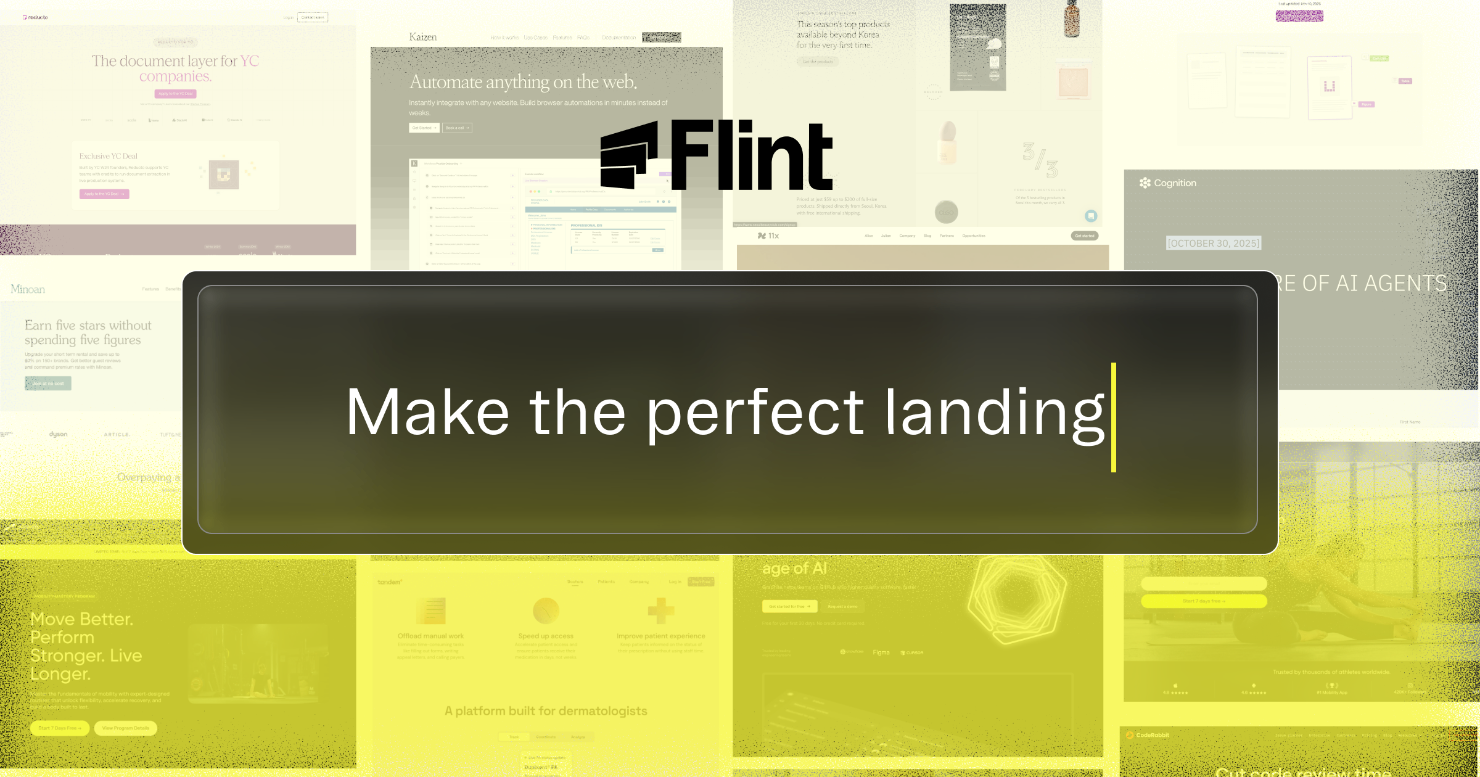
Flint is an AI landing-page platform for marketing and GTM teams that want to launch on-brand pages quickly, without heavy engineering involvement.
[1]
[2]
It emphasizes “brand extraction” from an existing homepage URL so new pages inherit the site’s design system rather than starting from templates.
[1]
[3]
Core features include natural-language page creation, spreadsheet/CSV-driven bulk generation, and publishing to custom domains or subdomains.
[4]
[5]
[6]
It also supports MCP/API integrations for tools like Claude, Codex, Clay , Airtable , CRMs , and Workflow Automation tools, plus analytics setup and Google Ads-related workflows.
[7]
[8]
[6]
[?]
Screenshots
No reliable source found.
Product Roadmap / Announcements
As of 2026-08-20,
- 2026-08-12 — Flint published migration guidance highlighting root-domain/subfolder publishing, analytics setup, and multiple workflow integrations. [6] [?] [?]
Recent Developments
History and Origin Story
Flint appears to have originated in 2023 and is associated with a YC S23 batch listing that names Sohan Choudhury and Jinseo Park as founders.
[15]
[16]
[17]
Flint’s public-facing material now frames the company around marketing-page generation for GTM teams, with product pages describing a move from generic builders toward “production-ready, on-brand campaign pages.”
[2]
[5]
[6]
Fundraising History
No reliable source found.
Notable Team Members
Sohan Choudhury is listed by Y Combinator as a founder of Flint.
[15]
[16]
[17]
No other leadership biographies were found in reliable sources in this search set.
Jinseo Park is also listed by Y Combinator as a founder of Flint.
[15]
[16]
[17]
No other leadership biographies were found in reliable sources in this search set.
Market Sizing
Category, Market Size, and Category Growth
Flint is best categorized as an AI landing-page builder / CRO platform / GTM web automation tool .
[2]
[8]
[11]
Its own positioning targets fast-growing B2B SaaS and AI companies that need campaign pages at high velocity, but no reliable market-size estimate was found in the search results.
[18]
[10]
Pricing
| Tier | Price | Notes |
| Free | $0/month | Limited monthly credits; hosting and API/MCP-driven creation are included. |
| Starter | $96/month billed annually | Includes 12,000 annual credits and custom-domain or subdomain publishing. |
| Custom | Contact sales | Higher limits, root-domain publishing, enterprise controls, and custom analytics integrations. |
| Sources for Table: [11] [?] [?] [14] |
Revenue Trajectory Estimates
No reliable source found.
Competitive Landscape
Who it’s for, who it’s not for
Flint is for marketing and GTM teams that need to generate many on-brand landing pages quickly, especially for campaigns, ABM, SEO, geo-targeting, or programmatic ads.
[2]
[9]
[18]
[10]
It is also positioned for teams that want less engineering involvement and prefer page generation from prompts, spreadsheets, or connected data sources.
[4]
[5]
[6]
It is not primarily for teams seeking a general-purpose website builder, a blank-canvas design tool, or a full application-development platform.
[5]
[6]
Flint’s own comparisons frame it as a specialized landing-page generator rather than a broad website platform.
[5]
[?]
Viable Alternatives
Competitor Table
| Competitor | Description |
| [Webflow] | General-purpose website builder and CMS used for broader site design and publishing. |
| [Framer] | Visual website builder with animations, CMS, and responsive design tools. |
| [Lovable] | AI builder Flint compares against for marketing landing pages. |
| [Bolt] | AI builder Flint compares against for marketing websites. |
| [Mutiny] | GTM personalization platform focused on modifying existing pages and CRM-driven personalization. |