


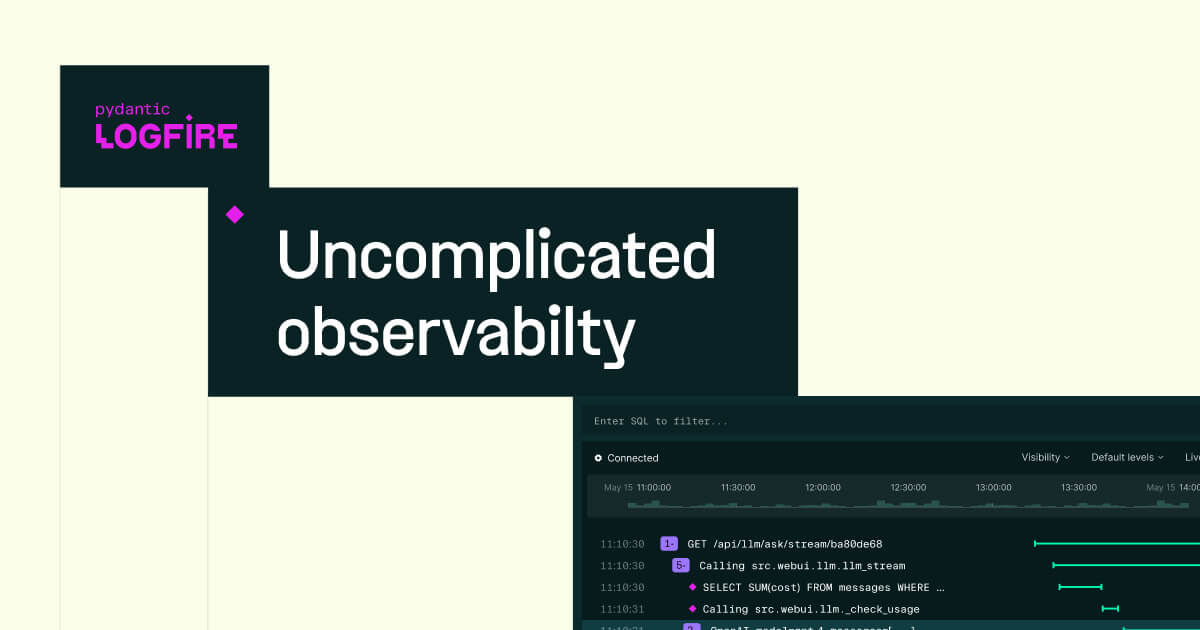

Value Proposition & Features
Logfire is an AI-native observability platform from the Pydantic team, designed to show an application’s complete behavior rather than only its LLM calls.
[1]
It is built as an opinionated wrapper around OpenTelemetry and supports traces, conversation replay, tool-call inspection, and token and cost breakdowns.
[1]
- Tool-call inspection: Examine the tools invoked by an agent and the resulting execution details. [1]
- Live agent views: Inspect agent runs, model runs, and decision spans through the Agent Run interface. [2]
- Dashboards: Create, clone, edit, and navigate dashboards with autosaving and improved performance. [4]
- Broad Pydantic integration: Logfire is positioned alongside Pydantic AI and Pydantic Evals as part of Pydantic’s AI engineering stack. [5]
Screenshots
No three official screenshot URLs were identified in the available search results.
Product Roadmap / Announcements
As of October 7, 2026,
- September 22, 2026: Logfire dashboards received a redesigned interface, including autosaving drafts, one-click cloning, improved keyboard navigation, and performance improvements. [4]
- September 15, 2026: Logfire added tracing for realtime AI Gateway sessions, including model, duration, close status, token usage, estimated cost, and metered-response spans. [6]
- September 2026: Logfire integrations demonstrated tracing for image generation, including generator, agent, and tool spans. [7]
- September 2026: Logfire added visibility into classifier decisions for Jev-backed agents, including questions, answers, probabilities, thresholds, and routing outcomes. [2]
Recent Developments
During the 90 days preceding October 7, 2026, Logfire’s publicly documented activity focused on dashboard redesign, realtime-audio observability, image-generation tracing, and deeper inspection of agent decisions.
[4]
[6]
[7]
[2]
The available results did not identify a separate independent Logfire funding, acquisition, or corporate announcement during this period.
History and Origin Story
Logfire originated within Pydantic’s broader AI engineering stack, which combines Pydantic AI , Pydantic Evals, AI Gateways , and observability capabilities for teams building AI applications.
[5]
The product evolved toward AI-native observability by combining OpenTelemetry instrumentation with agent-specific views such as conversation replay, tool-call inspection, token tracking, cost analysis, and decision tracing.
[1]
[3]
Fundraising History
The available source identifies funding for Pydantic , the parent organization, rather than a separately funded Logfire entity.
[5]
| Round | Date | Amount | Lead investor |
| Seed | 2023-02-16 | USD 4.7M | Not stated |
| Series A | 2024-10-01 | USD 12.5M | Not stated |
| Total | — | USD 17.17M reported | — |
The retrieved source reports Pydantic’s total funding as USD 17,170,379.
[5]
Investor names and round leads were not identified in the available search results.
Notable Team Members
The available results do not provide a reliable, complete list of Logfire founders or leadership. Petyo Ivanov is identified as having built the Logfire side of the Jev decision-observability integration.
[2]
Market Sizing
Category, Market Size, and Category Growth
Logfire fits the application-performance monitoring and observability category, with a specialized focus on AI agents and generative-AI workloads. Its distinguishing scope is the combination of standard OpenTelemetry instrumentation with AI-specific telemetry such as conversations, tool calls, token usage, costs, and model decisions.
[1]
[3]
Revenue Trajectory Estimates
No reliable reported revenue or ARR figures for Logfire were identified in the available search results.
Competitive Landscape
Who it’s for, who it’s not for
Logfire is aimed at teams building production AI applications or agents that need to inspect end-to-end behavior, including model requests, tool calls, conversations, token usage, costs, and routing decisions.
[1]
[2]
Its OpenTelemetry foundation also suits teams that want AI-specific observability without abandoning standard telemetry practices.
[1]
[3]
It is less suited to teams seeking only basic application logging, a standalone log viewer, or an observability product with no need for AI-agent tracing. This anti-ICP is an inference from Logfire’s documented emphasis on AI-agent behavior and GenAI telemetry.
[1]
Viable Alternatives
- DataDog : A broad observability platform that may suit organizations wanting logs, metrics, traces, and application monitoring in one established suite.
- New Relic : A general-purpose application-observability alternative for teams prioritizing traditional APM capabilities.
- Grafana Labs stack: A flexible option for teams preferring composable, self-managed dashboards and telemetry backends.
- Honeycomb : A trace- and event-oriented observability alternative for teams focused on high-cardinality debugging.
- Arize Phoenix: An AI-observability alternative focused on tracing and evaluation of LLM and agent applications.
The available search results did not provide direct, current comparison pages for these alternatives; these descriptions are category-level comparisons rather than claims drawn from Logfire’s own materials.
Competitor Table
| Competitor | Description |
| Datadog | Broad cloud monitoring and observability suite covering logs, metrics, traces, and application performance. |
| New Relic | General-purpose observability and application-performance monitoring platform. |
| Grafana | Composable observability ecosystem commonly used for dashboards, metrics, logs, and traces. |
| Honeycomb | Event- and trace-oriented observability platform designed for debugging complex systems. |
| Arize Phoenix | AI-observability platform for tracing, evaluating, and debugging LLM and agent applications. |
Logfire’s documented differentiation is its combination of OpenTelemetry with AI-agent-specific inspection, including conversation replay, tool-call visibility, token and cost analysis, and decision tracing.
[1]
[2]
[3]