


Team Topologies
Defining and Describing Team Topologies
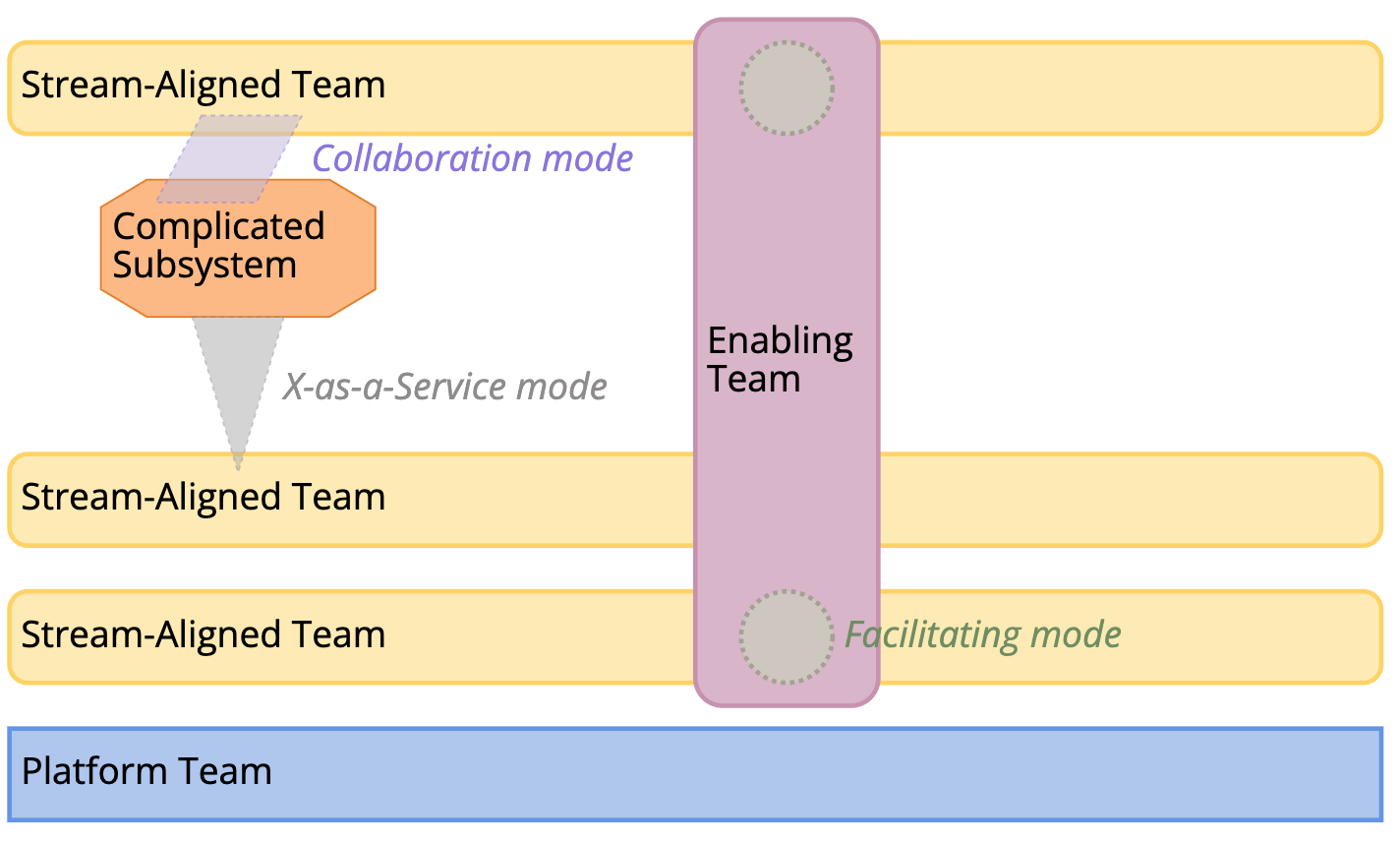
- Team Topologies is a practical model for structuring teams so value flows quickly without overwhelming people with unnecessary cognitive load.
- A stream-aligned team owns a continuous flow of value associated with a business domain, product, customer journey, or other meaningful stream. [2]
- An enabling team helps other teams acquire missing skills or adopt new practices, while a complicated-subsystem team owns a technically specialized area that requires concentrated expertise. [1]
Uses in Context
- Organizational Design : Leaders use the model to replace large, monolithic teams with smaller teams aligned to business domains and customer outcomes. [2] [4]
- Platform Strategy : Platform teams are invoked as internal product teams whose purpose is to simplify delivery for stream-aligned teams rather than create another layer of infrastructure ownership. [1] [2]
- Team interaction design: The framework helps organizations deliberately choose how teams collaborate, including temporary enabling relationships and clearer service boundaries. [3]
- Cognitive Load management: Practitioners use the term to describe reducing the number of unrelated systems, processes, and responsibilities each team must understand. [3] [5]
- Scaling Product Development Workflow : Organizations apply Team Topologies to create small, cross-functional teams while retaining specialized platform or enabling capabilities. [1] [6]
History of Use
Origins
Evolution
- October 2023: Alfa Financial Software reorganized its engineering group into product areas aligned with core business domains, using Team Topologies principles to clarify ownership and reduce cognitive load. [4]
- Late 2019 onward: loveholidays reorganized 130 data, product, and engineering staff into small, cross-functional “mission teams” of approximately five people, supported by dedicated platform teams. [6]
Best Real-World Examples
- Alfa Financial Software — aligned product areas with customer-understood business domains to make team boundaries clearer. [4]
- loveholidays — formed approximately five-person cross-functional mission teams and supported them with platform teams. [6]
- Pirate Ship Software — moved from overloaded feature teams to five stream-aligned teams and two platform teams. [7]
- REA Group Financial Services — restructured large, monolithic teams into smaller autonomous stream-aligned teams with a focus on flow efficiency and cognitive load. [8]
Case Studies
Sources
[1] 2026, Aug 12. teamtopologies.com . Team Topologies - Organizing for fast flow of value . Updated: 2026, Nov 10. Generated: 2026, Nov 14. Perplexity API response.
[2] 2026, Apr 07. teamtopologies.com . Yassir: Transforming a Super App with Team Topologies . Updated: 2026, Nov 06. Generated: 2026, Nov 14. Perplexity API response.
[3] 2026, Jul 25. teamtopologies.com . Creditas: Managing Team Cognitive Load with ... . Updated: 2026, Oct 31. Generated: 2026, Nov 14. Perplexity API response.
[4] 2026, Mar 17. teamtopologies.com . From Organic Growth to Intentional Flow: How Alfa ... . Updated: 2026, Nov 04. Generated: 2026, Nov 14. Perplexity API response.
[5] 2026, Jul 25. teamtopologies.com . Team Cognitive Load — Industry Examples — Team Topologies - Organizing for fast flow of value . Updated: 2026, Oct 29. Generated: 2026, Nov 14. Perplexity API response.
[6] 2026, Oct 31. teamtopologies.com . Scaling Value Delivery and AI-Native Engineering through ... . Updated: 2026, Nov 05. Generated: 2026, Nov 14. Perplexity API response.
[7] 2025, Nov 18. teamtopologies.com . Reteaming for Fast Flow: A Case Study from Pirate Ship ... . Updated: 2026, Nov 01. Generated: 2026, Nov 14. Perplexity API response.
[8] 2026, Mar 25. teamtopologies.com . REA — Industry Examples — Team Topologies - Organizing for fast ... . Updated: 2026, Nov 14. Generated: 2026, Nov 14. Perplexity API response.
[9] 2026, Oct 31. teamtopologies.com . teamtopologies.com › industry-examples › tagStream-aligned teams — Industry Examples — Team Topologies . Generated: 2026, Nov 14. Perplexity API response.
[10] 2026, Oct 18. teamtopologies.com . Industry Examples — Team Topologies - Organizing for fast flow of value . Updated: 2026, Oct 19. Generated: 2026, Nov 14. Perplexity API response.